A 460cc driver head sounds huge until you slice it 30 metres into the trees anyway. That’s the trap most weekend golfers fall into: they buy the biggest, most expensive “forgiving” driver on the shelf and still hit the same wayward shot they’ve hit for years. The most forgiving golf driver isn’t a single model — it’s whichever one matches your specific swing fault, and for 2026 that means paying attention to moment of inertia, weighting, and loft, not just the size sticker on the box.
Forgiveness Isn’t One Spec — It’s Three Working Together
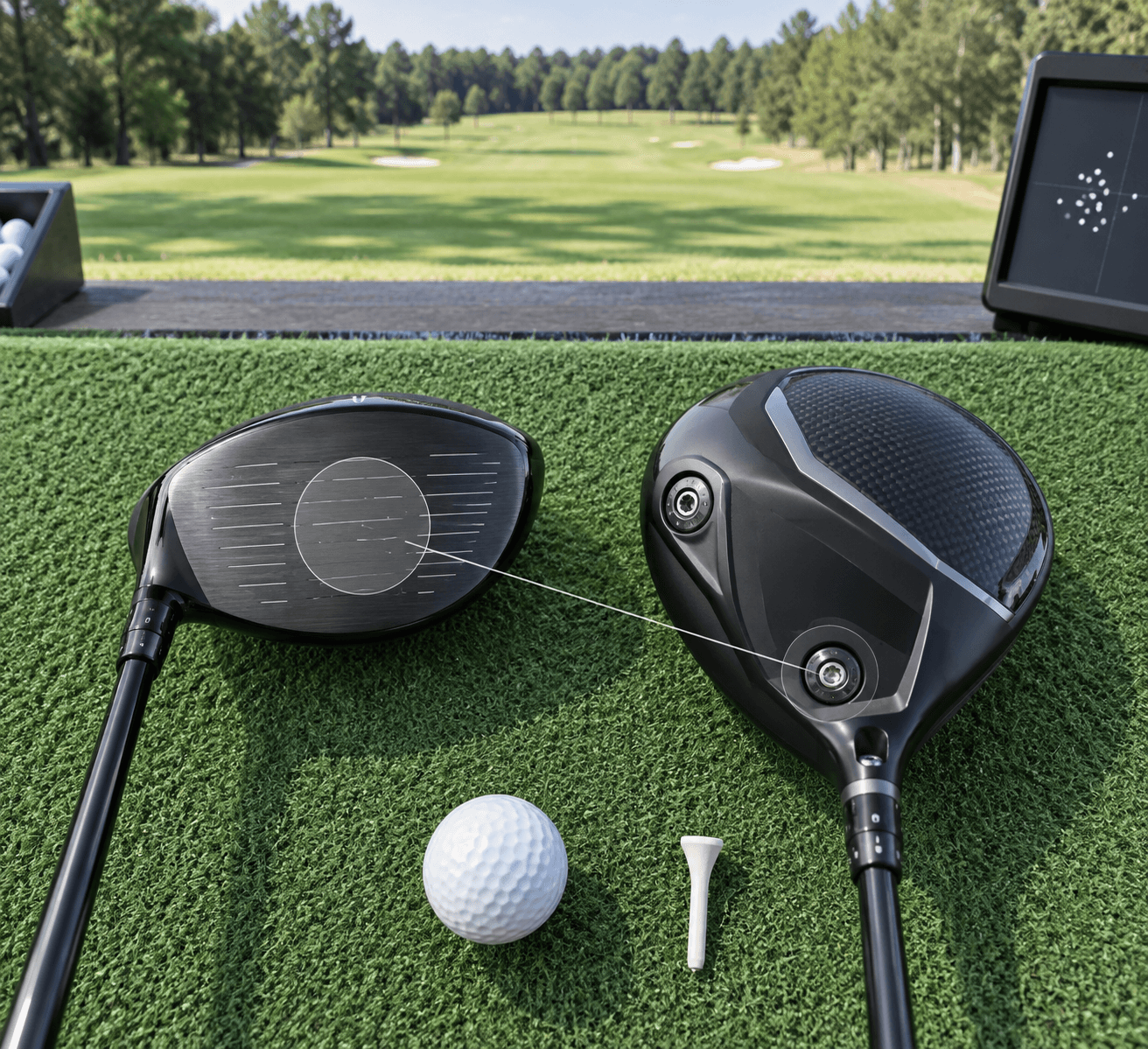
Forgiveness on a driver comes from MOI (moment of inertia), centre of gravity placement, and sweet spot size, and none of them work well alone. A big head with low MOI will still twist on off-centre strikes. Real forgiveness needs all three lined up for your particular miss.
MOI: The Number That Actually Matters
MOI measures how much the clubhead resists twisting when you catch the ball off-centre. Higher MOI (most 2026 game-improvement drivers sit around 9,000-10,000 g·cm²) means less clubface twist, straighter mishits, and less distance lost on a toe or heel strike. This matters more than clubhead shape ever will.
Centre of Gravity and Sweet Spot Size
A low, back-set centre of gravity boosts launch and cuts spin for slower swings, while a low-and-forward CG suits faster players chasing roll. The sweet spot itself has grown on modern carbon crown drivers because lighter crowns let designers push more weight to the perimeter, stretching the forgiving zone across the whole face rather than just the middle.
Buying on clubhead size alone, while ignoring MOI and weighting, is the single biggest mistake amateur buyers make. Two drivers can both be 460cc and play completely differently.
Matching the Driver to Your Actual Miss
Most players don’t have “a bad swing” — they have one recurring fault. Fix the driver for that fault first, and everything else gets easier.
If You Slice
Look for a draw-bias design with weight shifted toward the heel or an adjustable hosel you can dial toward draw. This closes the face fractionally at impact and can turn a 20-metre slice into a gentle fade. Brands like Callaway (Paradym/Ai Smoke range) and TaylorMade (Qi series) both build dedicated draw-bias versions alongside their standard heads.
If Your Strike Is Inconsistent
Prioritise raw MOI over draw bias. Players who catch the ball all over the face — high one day, off the toe the next — need a head that punishes mis-hits the least, not one that curves the ball a certain way.
If Your Swing Speed Is Low
Go up in loft. A slower swing (under roughly 85 mph) generates less spin naturally, so a 10.5° or even 12° loft launches the ball higher and holds it in the air longer, adding real carry distance. Skipping proper loft selection costs average golfers more forgiveness than any weighting trick.
Shaft Flex and Loft: The Overlooked Half of Forgiveness
A forgiving head on the wrong shaft is still an inconsistent driver. Shaft flex changes how the face returns to square through impact, which affects your dispersion just as much as MOI does.
Most average male golfers swinging 80-95 mph do best on a Regular or Senior flex, not Stiff. Ego gets in the way here constantly — golfers assume Stiff means better, when it actually means less help squaring the face if your tempo isn’t fast enough to load the shaft properly.
Loft selection follows the same logic. Beginners routinely play 9° drivers because that’s what’s stocked as “standard,” when 10.5° would launch higher, spin less on mis-hits, and genuinely add metres. This one change often does more for forgiveness than switching brands entirely.
What’s Actually Worth Buying in 2026
Here’s how the main forgiveness features stack up across driver categories, so you can see where your money goes.
Driver Type
Typical Price (UK)
MOI Focus
Best For
Premium tour-level
£550-£650
Moderate, workability-focused
Low handicappers wanting shot shape control
Game-improvement (2026)
£400-£500
High, max forgiveness
Average golfers, inconsistent strikers
Draw-bias specific
£400-£480
High, heel-weighted
Confirmed slicers
Budget/previous-gen
£150-£280
Good, slightly dated tech
Beginners on a budget
A £180 previous-generation driver from two seasons back often out-forgives a brand-new £600 tour model, simply because tour drivers trade MOI for workability. Don’t pay premium prices for a feature set built for better players than you.
Custom fitting closes the gap between spec sheet and actual result. A 20-minute session at a fitting bay, often free when tied to a purchase at retailers like American Golf, checks your launch angle, spin rate, and swing speed against real data instead of guesswork. If you’re weighing up a shortlist of forgiving drivers before you buy, a fitting session and a bit of research on a site like golfyet.com will tell you more than any spec sheet alone.
Book a fitting session before you buy, even a basic 20-minute one.
Identify your dominant miss: slice, thin strike, or lack of distance.
Choose loft based on swing speed, not tradition (10.5° for most amateurs).
Match shaft flex to actual tempo, not ego.
Pick MOI and draw-bias features based on your miss, not the marketing copy.
Re-test after six weeks of range use, since your swing will change.
None of this replaces practice. A forgiving driver shrinks your bad shots — it doesn’t erase your swing faults, and anyone telling you it will is selling something.
Frequently Asked Questions
What is the most forgiving golf driver for beginners in 2026?
There’s no single model — the most forgiving golf driver for a beginner is a high-MOI, draw-bias 460cc head at 10.5° loft on Regular flex, properly fitted. Buying by brand hype alone skips the fitting step that actually delivers forgiveness.
Does a bigger driver head always mean more forgiveness?
No. All modern drivers sit near the 460cc legal limit, so size differences are minimal. MOI, weighting, and centre of gravity placement affect forgiveness far more than a few extra cubic centimetres of head volume.
Is it worth paying extra for a premium 2026 driver over a budget one?
Usually not for average golfers. A £180-£280 previous-generation model often has similar MOI to a £600 tour driver, since tour drivers sacrifice some forgiveness for shot-shaping control most casual players don’t need.
Golf is not just a sport; it's a culture that encompasses a rich history and tradition. Part of this culture is dressing appropriately for the game, which is why understanding the dress code is essential…
Anthony Kim once beat Sergio García 5&4 in Ryder Cup singles at Valhalla in 2008, then walked away from professional golf at the peak of his powers. That vanishing act made him one of golf's…
Golfers often face situations where they wish they could redo a shot. A mulligan provides a second chance, allowing a player to replay a stroke without penalty, although it's not part of the official golf…