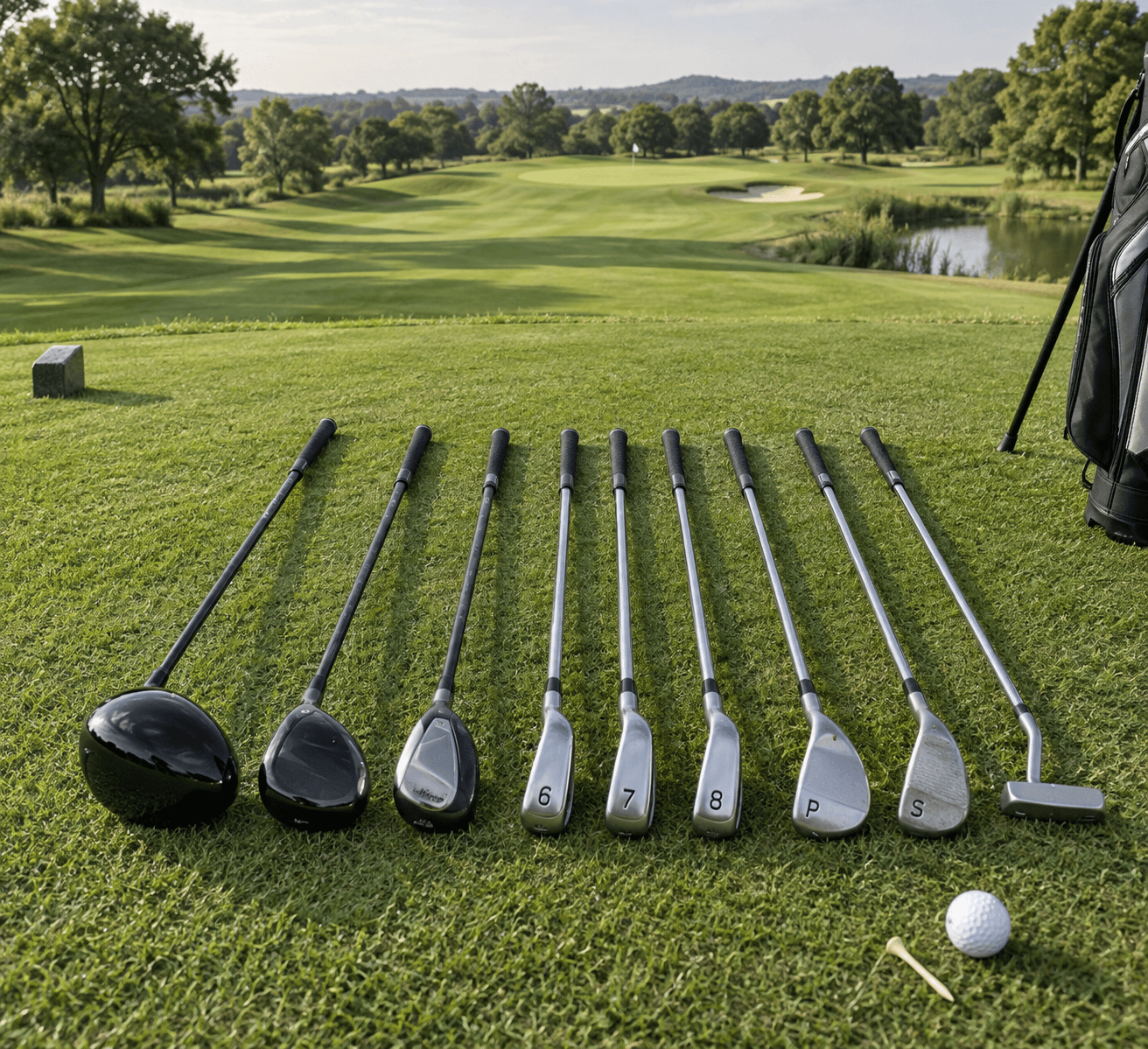
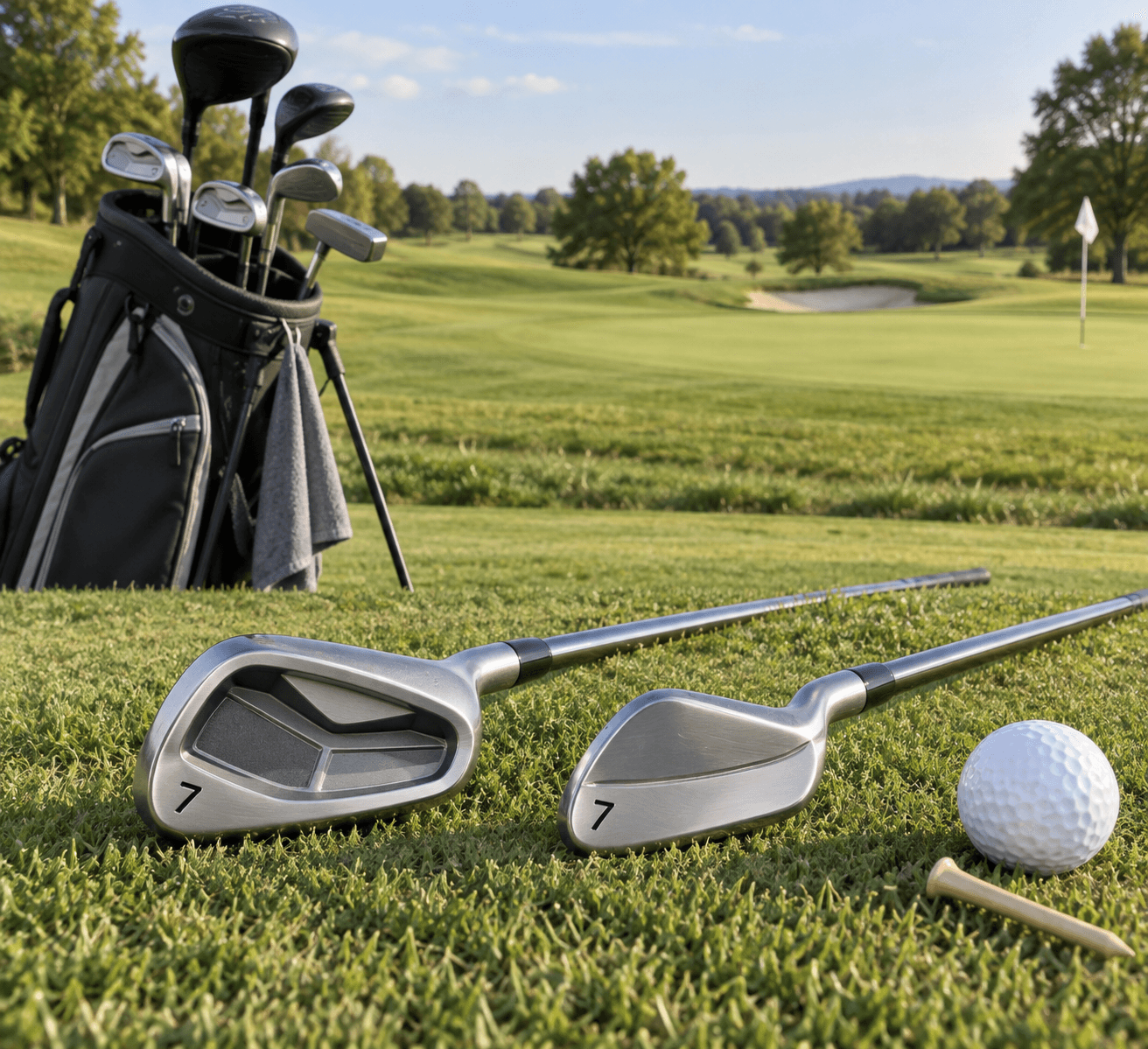
You’re allowed 14 clubs in your bag, and most beginners are better off carrying 8 or 9. If you’ve searched for golf sticks types, you’re probably staring at a wall of drivers, irons and wedges wondering what any of it does. Here’s the plain version: what each club is for, which ones to skip at first, and where the distance gaps actually matter.
The Four Club Families and What Each One Does
Every club in your bag belongs to one of four families: woods, irons, wedges and putters. Hybrids sit between woods and irons. Each family solves a different problem, so you don’t need a dozen of each.
Drivers and Fairway Woods
The driver is the biggest club and hits the ball furthest off the tee. It’s also the hardest to control, and it isn’t the right call on every par 4 or 5. If the fairway is narrow, a fairway wood or hybrid off the tee keeps you in play and costs you only 20 to 30 yards.
A 3-wood or 5-wood does the same job from the fairway, with a smaller head and more loft. Loft is the angle of the clubface, and more of it sends the ball higher and shorter.
Hybrids
Hybrids look like a small wood but swing like an iron. They launch the ball high from rough and bad lies, which is why they replace the hard-to-hit long irons. Don’t think of them as a beginner crutch, though. Plenty of tour pros carry two or three.
Irons
Irons are numbered, usually 4 to 9, and the number tells you the loft. A higher number means more loft and a shorter shot, so a 9-iron goes far less distance than a 5-iron. Long irons (3-5) are tough to hit, mid irons (6-7) are your workhorses, and short irons (8-9) give you height and control into greens.
Putters
Putters come in two main shapes. A blade is slim and traditional, rewarding a good touch. A mallet has a bigger head, which makes it more forgiving on off-centre strikes. I’d start with a mallet. The drawback is that some golfers find them less feel-friendly on fast greens.
Wedges: Where Distance Gaps Really Matter
Wedges are your scoring clubs, played within about 120 yards of the green. This is where most beginners lose shots, because they own two wedges that leave a big hole in their yardages.
Here’s a typical setup. Distances are rough estimates for an average male amateur, and many golfers hit shorter.
Wedge
Typical loft
Estimated carry
Pitching wedge
44-47°
100-120 yards
Gap wedge
50-52°
85-100 yards
Sand wedge
54-56°
70-85 yards
Lob wedge
58-60°
50-70 yards
The rule of thumb is about 4 to 6 degrees between wedges, which gives you a 10 to 15 yard step. Bigger jumps leave awkward in-between shots where you’re forced to swing at half power.
You don’t need all four on day one. A pitching wedge and a sand wedge cover most situations, and a gap wedge fills the hole when you’re ready. Skip the lob wedge at first. It’s the hardest club to control, and it tempts you into high, risky shots you can’t yet pull off.
Build a Beginner Bag With 7 to 10 Clubs
More clubs doesn’t mean better golf. Fewer clubs means fewer decisions, and you’ll learn what each one does faster. Here’s a sensible order to build from.
That’s ten clubs, and you can cut the list at seven and still play a full round. Leave out the 3, 4 and 5 irons, the lob wedge and a second fairway wood. A half set from a brand like Wilson or Callaway often costs £200-£400 new, and used sets go for less.
Check the distance steps as you build. Between irons you want roughly 10 yards per club. If two clubs go the same distance, one of them is wasted space.
Shaft Flex, Club Fitting and Choosing Your Style
Shaft Flex and Length
Shafts come in flex ratings: ladies, senior, regular and stiff. Slower swings suit softer flex, because it helps launch the ball. Most beginners should pick regular or softer, since a stiff shaft on a slow swing makes the ball fly low and right. Longer clubs go further but are harder to hit squarely, so don’t buy extra length for its own sake.
Game-Improvement vs Players Clubs
Game-improvement irons have wide soles and a forgiving face, so mishits still fly reasonably straight. Players clubs have thinner heads and reward precise strikes, but punish mistakes. Buy game-improvement. You can switch later, and many low-handicappers never do.
Do You Need a Fitting?
A fitting measures your swing speed and adjusts length, lie and flex. It’s worth it once you’ve played regularly for a few months and your swing has settled. Fitting sessions at UK golf shops are often free if you buy the clubs, otherwise expect around £50-£100. If you want more kit guidance, golfyet.com has beginner gear guides that cover this in more depth.
Frequently Asked Questions
How many golf clubs can you carry?
The Rules of Golf set a maximum of 14 clubs. Carrying more brings a penalty of two strokes per hole, up to four strokes in a round. Beginners usually play well with 8 to 10, which also makes the bag lighter to carry.
Which golf club goes the furthest?
The driver goes furthest, as it has the lowest loft and longest shaft. Beginners often carry it 180 to 220 yards, though that varies a lot with swing speed. A well-struck 3-wood can match a poorly hit driver.
Do I need a 3-iron, 4-iron or 5-iron?
No. These long irons are hard to hit, and a hybrid replaces them with a higher, easier launch. Most beginners do better with a 4-hybrid and 5-hybrid than a full set of long irons.
Golf tournaments, especially charity events and fundraisers, frequently adopt the scramble format due to its engaging team dynamics and faster play pace.The team format allows golfers of various skill levels to participate together, creating a…
Golf courses often implement the 90-Degree Rule to balance the convenience of using golf carts with the need to protect the fairway grass.This rule allows golfers to ride on the fairway while ensuring that carts…
During unfavorable weather conditions, golf courses often implement special provisions to ensure fair play despite challenging course conditions. These provisions, commonly referred to as winter rules or "preferred lies," allow golfers to improve their ball's…