Golf Club Distance Charts By Age, Gender And Skill Level
9 August, 2026Logan Hart0 Comments1 category
A 90 mph swing speed hits a driver about 220 to 230 yards. A 105 mph swing speed clears 280. That gap explains more about your golf game than your age or gender ever will, and it’s exactly why a distance chart for golf clubs only works when you read it the right way.
Most golfers pull up a chart, find their category, and treat the number like a grade on a report card. That’s backwards. A distance chart for golf clubs is a starting point for spotting gaps in your bag, not a scoreboard to chase.
Driver And Fairway Wood Distances: What’s Actually Average
The average amateur driver distance sits closer to 214 yards, not the 280-plus yards you see on TV broadcasts every weekend. That single fact resets expectations for most weekend players who compare themselves to tour highlights instead of realistic peers.
Driver Numbers By Skill Level
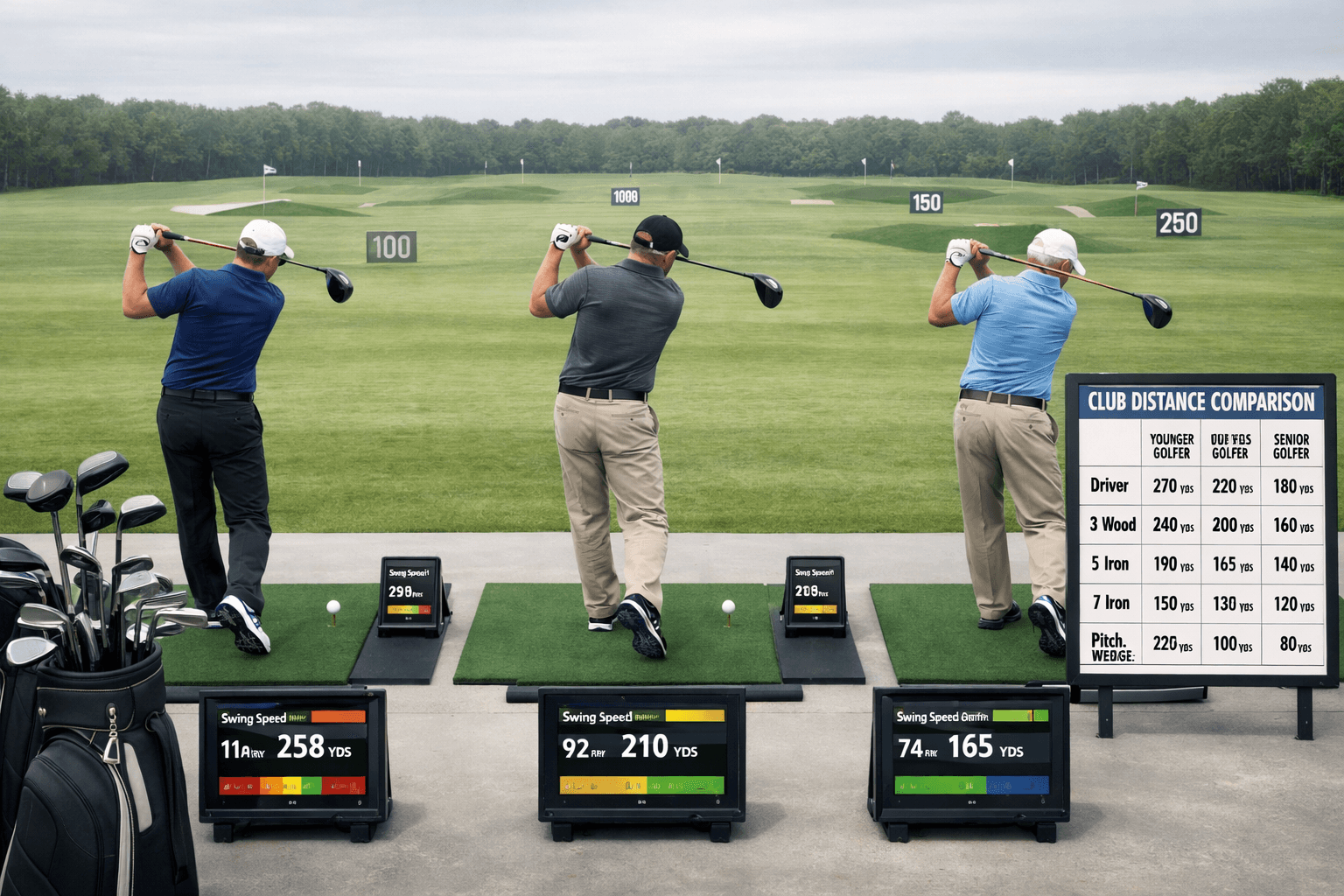
A beginner swinging under 80 mph typically carries a driver 180 to 200 yards. An intermediate player in the 85-95 mph range lands between 220 and 245 yards. Advanced players pushing 100-110 mph reach 250 to 275 yards, and tour pros averaging 113-115 mph regularly clear 295 to 320 yards off the tee.
Fairway Woods And Hybrids Fill The Gaps
A 3-wood usually travels 15 to 25 yards shorter than driver for the same swing speed, and a 5-wood trims another 10 to 15 yards off that. Hybrids replace long irons for a reason: a 3-hybrid at moderate swing speed covers roughly 190 to 200 yards with far more forgiveness than a 3-iron. If your fairway wood distances overlap your driver or your hybrid, that’s a gapping problem worth fixing before you touch anything else in the bag.
Iron Distance Ranges From 3-Iron Through 9-Iron
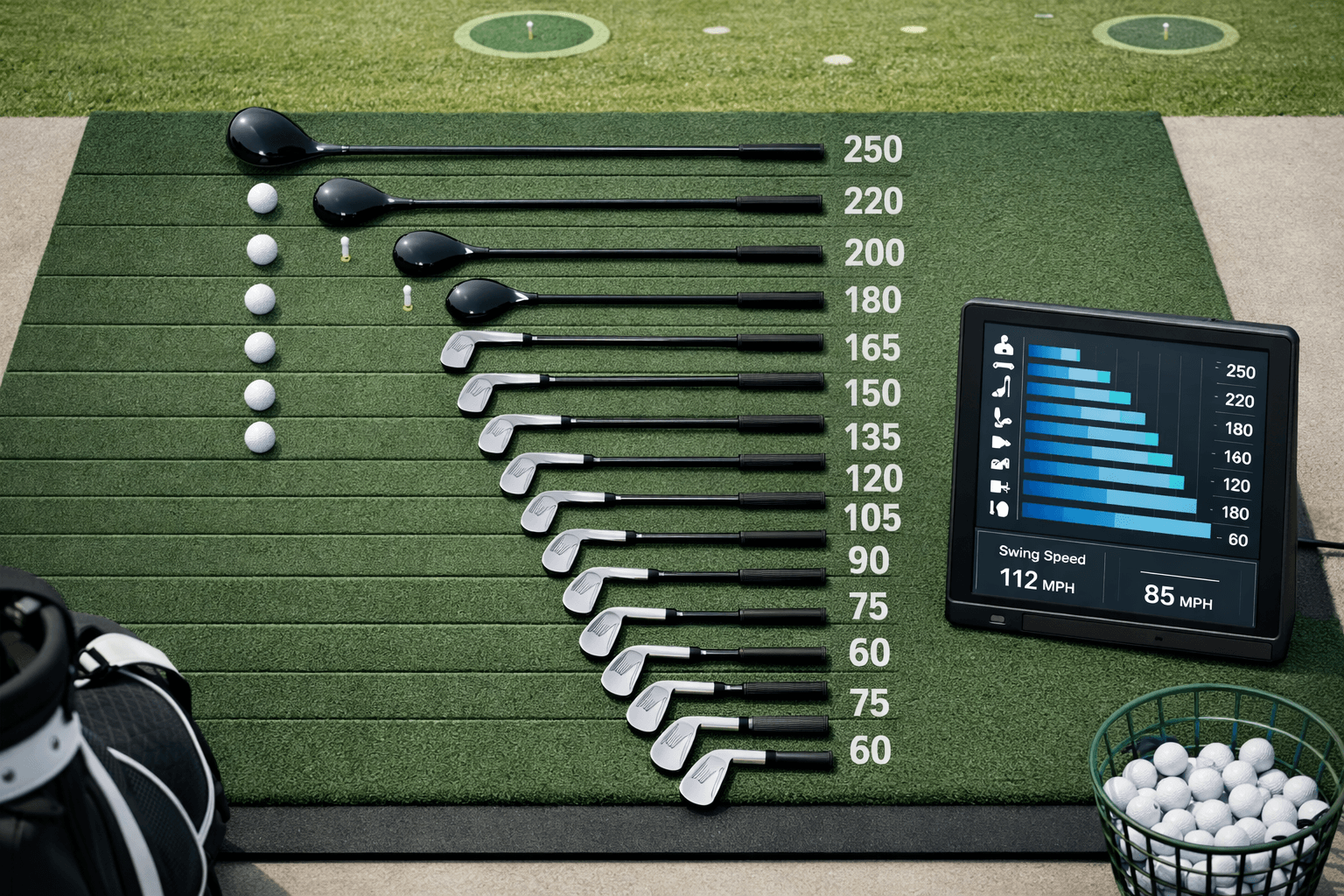
Iron distances scale down in fairly even 10 to 15 yard steps between clubs, and that consistency matters more than any single number. A well-fit set should have no two irons landing on the same yardage window.
Club
Beginner (yards)
Intermediate (yards)
Advanced (yards)
3-iron
140-150
170-180
190-200
5-iron
130-140
155-165
175-185
7-iron
110-120
135-145
150-160
9-iron
95-105
115-125
130-140
These ranges come from typical clubhead speed brackets, not a single fixed swing. If your 7-iron and 9-iron travel the same distance, the issue usually isn’t the clubs, it’s tempo or setup, and a session with a coach or launch monitor will show it fast.
Wedge Yardages And Why They’re Often Ignored
Wedges get less attention than drivers, but they’re where strokes actually get saved. A pitching wedge generally runs 15 to 20 yards shorter than a 9-iron, a gap wedge sits another 10 to 15 yards below that, and a sand wedge and lob wedge handle the final 20 to 80 yard window most players badly misjudge.
Full-swing wedge distances for an intermediate player look roughly like this: pitching wedge 100-110 yards, gap wedge 90-100 yards, sand wedge 75-85 yards, lob wedge 50-65 yards. Beginners should expect 10 to 15 yards less across the board, and advanced players often add 10 yards on top.
Putters and true short-game shots never belong on a distance chart. Chipping, bunker play, and putting are about feel and distance control, not raw yardage benchmarks, so charts rightly leave them out.
Age, Gender, And Skill Level: The Real Factors Behind The Numbers
Age and gender shift average swing speed, but they don’t determine your distance directly. Swing speed does that job, and it’s measurable in a single range session.
How Age Affects Swing Speed
Clubhead speed generally peaks in the late 20s to early 30s and declines gradually after 50, often by 1 to 2 mph per year without strength or mobility work. A 60-year-old golfer who stays active and trains rotational strength can easily out-swing a sedentary 35-year-old. Age is a tendency, not a rule.
Why Gender Gaps Are About Speed, Not Sex
The average LPGA driver swing speed sits around 94 mph, while the average PGA Tour swing speed is closer to 113 mph. That’s a real gap, but it’s a speed gap, not a gender rule carved in stone. Plenty of women swing faster than plenty of men, and distance charts split by gender are really just splitting by average speed clusters.
Matching Skill Level To Realistic Expectations
Here’s how most charts break skill into four rough tiers:
Beginner – under six months of consistent play, swing speeds typically under 85 mph.
Intermediate – handicap roughly 15-25, swing speeds around 85-95 mph.
Advanced – single-digit to low double-digit handicap, swing speeds around 95-110 mph.
Tour professional – swing speeds regularly above 113 mph with elite consistency.
Comparing your numbers to the wrong tier is the fastest way to feel discouraged for no good reason.
Getting Fit Instead Of Guessing From A Chart
A distance chart for golf clubs tells you what’s typical. A club fitting tells you what’s true for your swing. That difference is worth real money and real strokes.
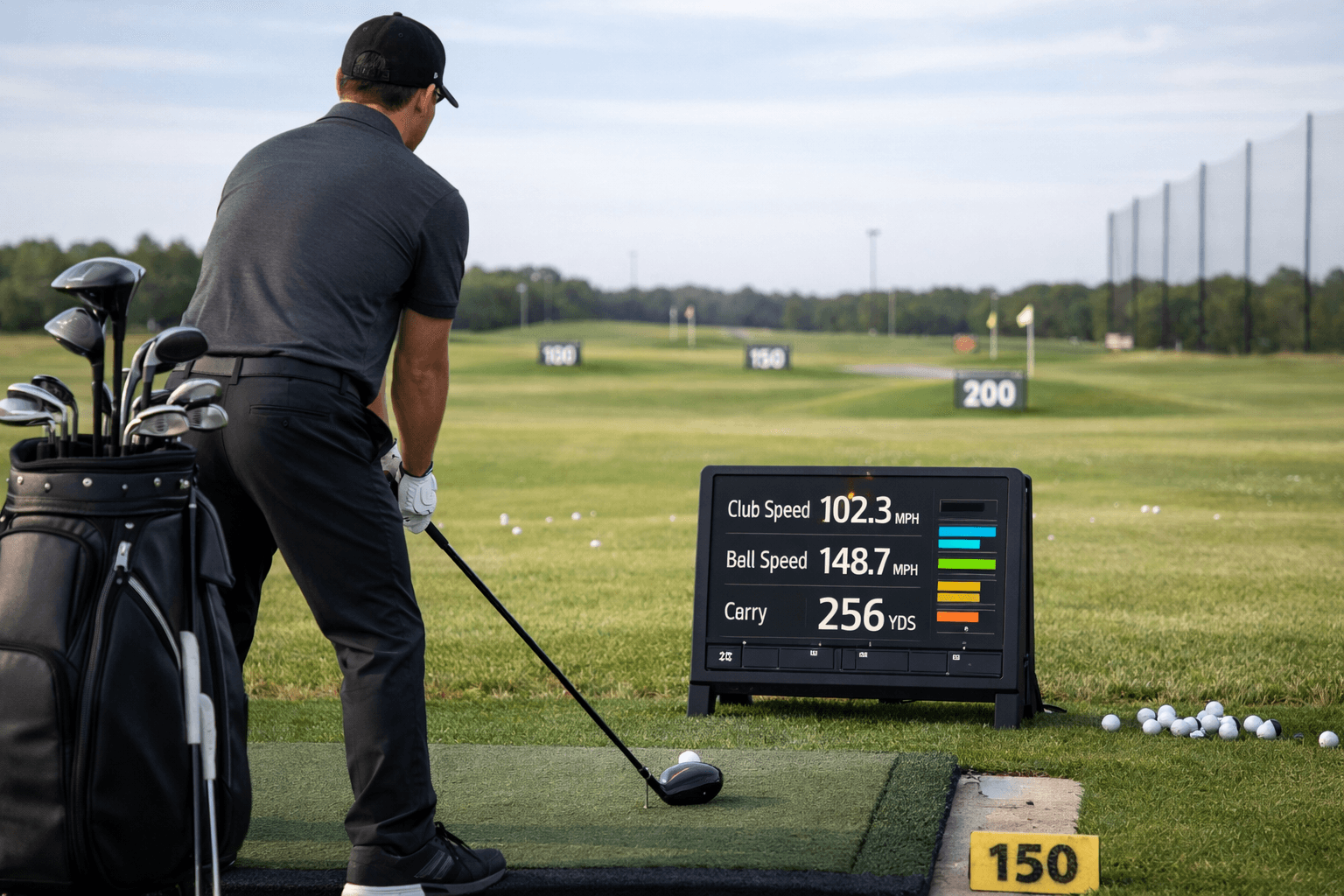
A proper fitting session on a launch monitor measures your actual clubhead speed, ball speed, launch angle, and spin rate, then matches shaft flex and loft to those numbers instead of a printed average. Golfyet.com has fitting guidance that walks through what to expect at a typical session, which runs anywhere from 60 to 90 minutes at most golf retailers. Skipping this step and buying clubs off a chart is the single most common mistake amateur buyers make, especially parents shopping for a junior set based on age alone rather than actual swing speed.
I’d rather see a golfer spend $150 on a fitting than $600 on a new driver picked from a shelf. The fitting exposes real gapping issues, weak spots in specific clubs, inconsistent carry distances, that no chart can catch because charts only show averages, never your swing.
Frequently Asked Questions
What is a good driver distance for a mid-handicap golfer?
A mid-handicap golfer, roughly a 15-20 handicap, typically carries a driver 220 to 240 yards total. Anything close to that range is solid; chasing 270-plus based on tour footage sets an unrealistic bar.
Do distance charts account for altitude or ball type?
No, standard distance charts assume sea level and a mid-compression ball in normal temperature. Playing at altitude can add 5 to 10 percent more carry, and a low-compression ball can shift numbers a few yards either way.
How much does swing speed really change with age?
Swing speed often drops 1 to 2 mph per year after age 50 without regular strength training, but active golfers frequently hold onto their speed well into their 60s. Fitness matters more than the calendar here.
The United States Golf Association (USGA) and The R&A have announced updates to the Rules of Golf, set to take effect on January 1, 2023.These changes aim to make the game more accessible and easier…
Mark your calendar for a course most golf fans have never seen on TV: Aronimink Golf Club near Philadelphia hosts the PGA Championship 2026, and it's not the venue you're used to hearing about every…
The PGA TOUR is set to introduce distance-measuring devices for select events in 2025, aiming to enhance the pace of play during competitions.Distance-measuring devices, commonly known as rangefinders, enable golfers and their caddies to quickly…