Shinnecock Hills Golf Club: A Historic Course Overview
11 August, 2026Logan Hart0 Comments1 category
Five U.S. Opens. One founding membership in the USGA. And a golf course that turned Phil Mickelson so upside down at the 2018 Open that he swatted a moving ball out of pure frustration. Shinnecock Hills Golf Club isn’t just old — it’s one of the reasons American golf looks the way it does today.
If you’re searching for facts on this Southampton, New York club, you probably watched it on TV during a U.S. Open and want the real story: how old it is, how hard it plays, and whether you’ll ever get a tee time there. The honest answer to that last part comes later, but it’s worth knowing upfront.
The 1891 Founding That Shaped American Golf
Shinnecock Hills opened in 1891, making it one of the oldest golf clubs in the United States still operating on close to its original grounds. It’s not a modern retro-throwback design pretending to be old-school — it is old-school, full stop.
The club was a founding member of the United States Golf Association in 1894, putting it in the room when American golf first organized itself with rules and a governing body. That’s a different level of historical weight than most “historic” courses claim. Pinehurst No. 2 and Chicago Golf Club share that early lineage, but Shinnecock’s founding predates both as a formal club with a clubhouse designed by Stanford White, one of the most recognized architects of the era.
From Original Design to Flynn’s Redesign
The course golfers watch today isn’t the 1891 layout. William Flynn redesigned Shinnecock Hills in the late 1920s, reshaping it into the routing that hosts U.S. Opens now. Flynn is the same architect behind Cherry Hills and Merion’s later work, and his fingerprints are why Shinnecock plays like a true links course despite sitting on Long Island instead of the Scottish coast.
People sometimes confuse Shinnecock Hills with Shinnecock Golf Club or other nearby Long Island clubs. They’re not the same place, and mixing them up is an easy way to look lost in a golf conversation.
Why the Course Plays So Hard: Wind, Firm Ground, and Length
Shinnecock Hills plays to roughly 7,445 yards from the tips for U.S. Open setups, but the yardage isn’t what breaks scorecards. It’s the wind coming off Peconic Bay and the fairways that run firm and fast, turning routine shots into guessing games about roll-out.
Links-Style Features That Punish Bad Angles
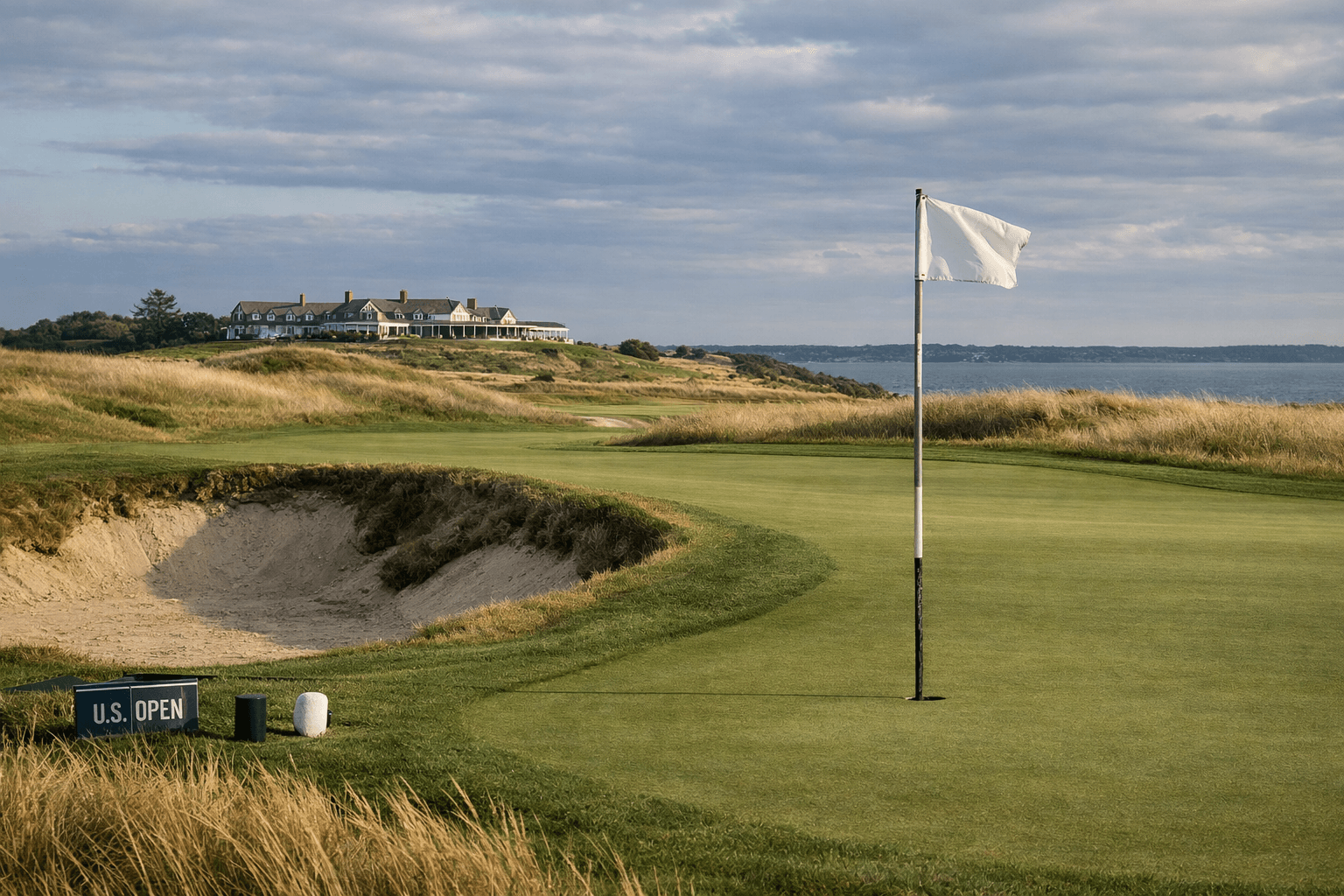
The course has few trees, wide-open exposure, and fescue rough that grabs anything slightly off-line. That’s a links-style identity, built for ground game golf rather than target golf through the air. Miss a fairway at Shinnecock and you’re not chipping out from behind a tree — you’re hacking through knee-high grass that doesn’t care how good your short game is.
The 2004 and 2018 Scoring Lessons
The 2004 U.S. Open got so firm and fast that greens turned nearly unplayable, and the USGA took heat for letting conditions get away from them. In 2018, wind gusts and baked-out fairways again pushed scores well over par, with Brooks Koepka’s winning total finishing at 1-over. That’s the tell: Shinnecock doesn’t need extra length to defend itself, it needs weather. A calm, soft week and the course plays two shots easier across the board.
U.S. Open Year
Winner
Winning Score
Key Condition
1986
Raymond Floyd
1-under
Firm greens, moderate wind
1995
Corey Pavin
-2
Fast fairways
2004
Retief Goosen
-4
Greens nearly unplayable
2018
Brooks Koepka
+1
High wind, extreme firmness
Membership and Access: Why This Isn’t a Bucket-List Course
Shinnecock Hills is a private club, and getting a round there almost always means knowing a member willing to sponsor your visit. There’s no public tee sheet, no resort package, and no walk-up rate like you’d find at Pebble Beach or Bandon Dunes.
That surprises casual fans who assume any U.S. Open venue takes outside bookings. It doesn’t work that way here. The membership is intentionally small, and the club has stayed that way for over a century specifically to protect the experience for the people who belong.
Here’s the reframe worth sitting with: Shinnecock is a better course to study than to chase. Most golfers will never walk its fairways, and that’s fine, because the real value is in what you can steal from watching it. A few things worth tracking next time it hosts:
Watch how pros play conservative lines off the tee instead of chasing distance.
Notice how they take extra club into firm greens to avoid short-siding themselves.
Pay attention to how wind direction changes strategy hole to hole, not just shot to shot.
Study how the pros manage fescue rough rather than trying to muscle out of it.
See how putting strategy shifts on fast, sloped greens — lag putting becomes survival, not just style.
Sites like golfyet.com break down that kind of U.S. Open strategy in plain terms, which is a faster way to actually improve your own course management than dreaming about a tee time you’ll probably never get.
Signature Holes and Championship Moments
The par-3 7th hole, sometimes called “Redan,” is the most photographed hole at Shinnecock and one of the toughest short holes in U.S. Open rotation. It sits exposed to full wind with a green that slopes away from most approach angles.
The closing stretch, holes 16 through 18, has decided championships more than once. Koepka’s 2018 win came down to steady par golf on those closing holes while others made mistakes trying to force birdies.
Notable champions across Shinnecock’s Open history include Ray Floyd, Corey Pavin, Retief Goosen, and Brooks Koepka — a list that skews toward patient, mistake-avoiding golf rather than pure power. That’s not a coincidence. The course rewards discipline over aggression, which is exactly the lesson weekend golfers tend to ignore on their own home course.
Frequently Asked Questions
Can the public play Shinnecock Hills Golf Club?
No. Shinnecock Hills is a private club with no public tee times, resort packages, or walk-up access. Visits generally require an invitation from a member, which makes it far more restricted than public U.S. Open sites like Pebble Beach or Torrey Pines.
How many U.S. Opens has Shinnecock Hills hosted?
Shinnecock Hills has hosted five U.S. Opens: 1896, 1986, 1995, 2004, and 2018. It’s scheduled to host again, continuing a rotation the USGA treats as one of its marquee venues alongside Pebble Beach and Oakmont.
Why does Shinnecock play so much harder in windy years?
Wind exposes the course’s lack of trees and turns firm, fast fairways into unpredictable bounces, adding difficulty without changing yardage. In calmer years, like parts of 1986 and 1995, scoring dropped noticeably compared to the brutal conditions of 2004 and 2018.
Golfers of varying skill levels often come together to enjoy the game in a competitive yet friendly format. One popular way to do this is through a two-player team format known as a scramble.In this…
Fourteen clubs, a dozen balls, three gloves, and a rain jacket you swear you'll never need — that's what a golf bag has to carry around 18 holes without falling apart. Most players buy a…
Golf is a game that values respect and courtesy on the course. Understanding the basics of etiquette is crucial for a positive experience for all golfers.Proper behavior on the course affects not only the pace…