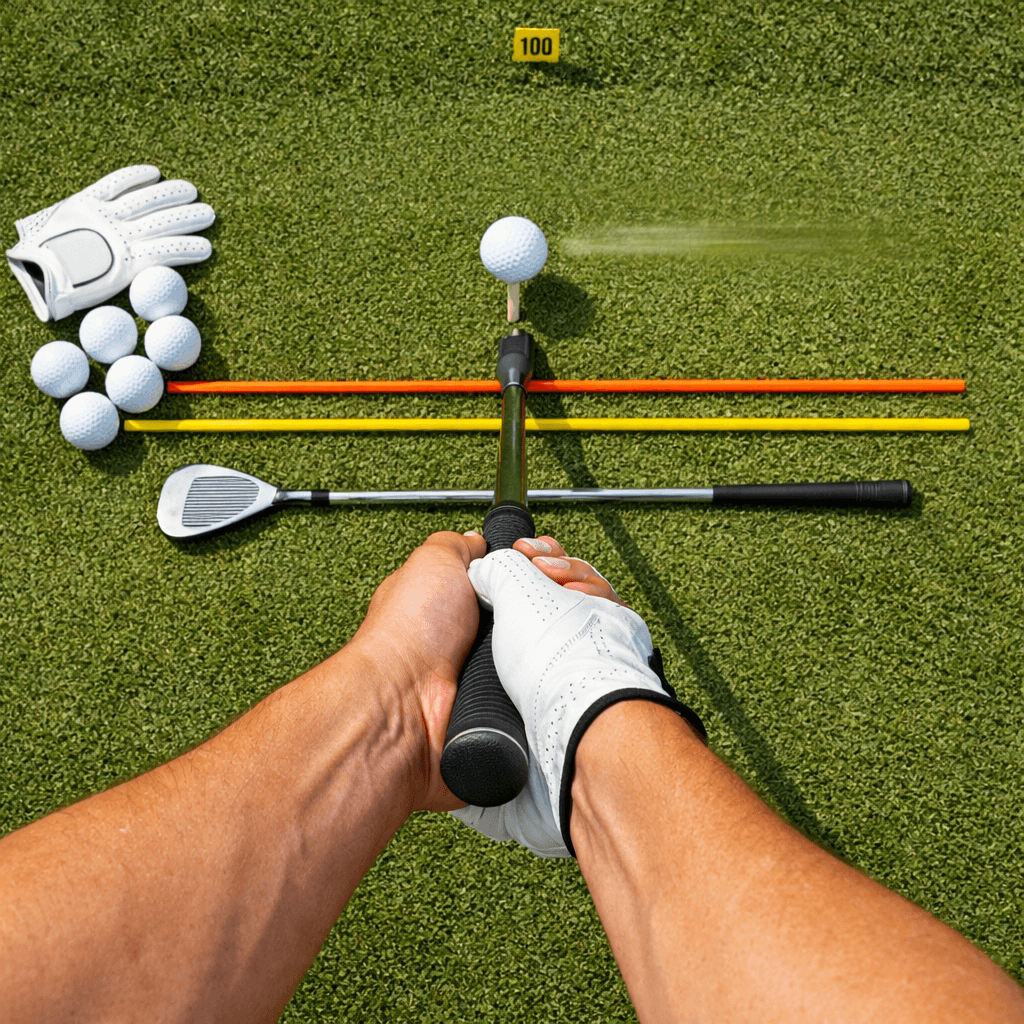
Here’s the part nobody tells you at the driving range: your swing doesn’t matter yet. If your grip and stance are off before you take the club back, no amount of “swing mechanics” advice will save the shot. Golf mechanics starts at setup, not motion.
Most beginners skip straight to backswing tips because that’s where the action looks like it happens. But a slice, a chunk, or a topped shot almost always traces back to something you did before the club ever moved. Fix that first, and the swing gets a lot less complicated.
Grip and Stance: The Setup Mistakes That Ruin Everything Downstream
Your grip and stance decide what your swing is physically capable of doing before you take the club back. Get these wrong and you’re fighting your own body for the whole motion. Get them right and half your “swing problems” disappear without a single swing thought.
Grip Pressure Kills Clubhead Speed
Grip the club like you’re squeezing toothpaste out slowly, not wringing out a towel. A death grip locks your wrists and kills the natural hinge that generates clubhead speed. Most beginners grip around a 7 or 8 out of 10 on the tightness scale; you want closer to a 4. Hold the club up, let your arms hang, and check that you can still wiggle your fingers before you address the ball.
Stance Width and Ball Position Set Up Contact
Stance width should roughly match shoulder width for mid-irons, widening slightly for a driver and narrowing for wedges. Ball position matters more than most beginners realize: play it off the front heel for a driver, center it for a 7-iron, and move it back an inch or two for wedges and short irons. Move the ball two inches forward without adjusting anything else, and you’ll start hitting behind it consistently. That’s not a swing flaw. That’s a setup flaw wearing a swing costume.
Alignment and Posture: Why Good Swings Still Miss Right
Alignment is the most ignored fundamental in beginner golf, and it’s the reason technically sound swings still miss the fairway. Your feet, hips, and shoulders need to point parallel to your target line, not directly at it. Lay two clubs on the ground at the range: one along your toe line, one pointing at the target. You’ll likely see they don’t match, and that gap explains a lot of your misses.
Posture matters just as much. Bend from the hips, not the waist, keep a slight knee flex, and let your arms hang naturally under your shoulders. Standing too upright forces you to lift the club with your arms instead of turning your body, which flattens your swing plane and steals power.
Here’s a quick benchmark table for setup basics across common clubs:
Club Type
Stance Width
Ball Position
Spine Tilt
Driver
Shoulder width or slightly wider
Off front heel
More tilted away from target
Mid-iron (6-7)
Shoulder width
Center of stance
Slight tilt
Wedge
Narrower than shoulders
Center to back of stance
Minimal tilt
The Backswing and Downswing: Building the Motion in the Right Order
Once setup is solid, the swing itself breaks into a simple sequence: turn back, shift down, rotate through. The backswing isn’t about lifting the club with your arms; it’s about turning your shoulders and hips while your arms stay connected to your chest. Think of it as loading a spring, not hoisting a weight.
The downswing starts from the ground up, not the top down. Your hips should start rotating toward the target before your arms and club catch up. This is the single biggest timing fix for beginners who feel like they’re “swinging over the top” or slicing everything right. If you start the downswing with your shoulders and hands instead of your hips, the club gets stuck outside its natural path every time.
Weight transfer follows the same order. Feel roughly 60% of your weight on your back foot at the top of the backswing, then shift it forward through impact so you finish with most of your weight on your front foot. Skip this step and you’ll hit a lot of thin, weak shots that feel like you did everything right but the ball didn’t listen.
Follow-Through and Tempo: The Two Things Beginners Rush Past
A full, balanced follow-through isn’t decoration. It’s proof your swing actually rotated through impact instead of stopping at the ball. If you can’t hold your finish for a full three seconds with your chest facing the target, something upstream broke down.
Tempo matters more than raw effort. Swinging harder for distance is one of the most common beginner mistakes, and it almost always backfires. Clubhead speed comes from sequencing and rotation, not muscle. A smooth 3-to-1 backswing-to-downswing tempo ratio (slower back, quicker through) produces more consistent contact than a fast, jerky swing built on tension.
A few drills fix these issues faster than range balls alone:
Practice your grip and stance in front of a mirror before ever hitting a ball.
Use the alignment-club drill on every range session for two weeks straight.
Swing at 70% effort for 20 balls to build tempo before adding power back in.
Pause at the top of your backswing to feel the hip-first downswing sequence.
Finish every swing and hold the pose to check balance and rotation.
Film your swing from the side once a week to track setup consistency.
Sites like golfyet.com run beginner-friendly drill breakdowns if you want video reference alongside these steps, which helps a lot when you’re trying to feel a motion you can’t quite see yourself making.
One more habit to kill early: lifting your head or upper body before the club reaches the ball. It feels natural, since you want to see where the shot’s going, but it pulls your whole swing plane up and causes thin or topped contact. Keep your chest down and let your body rotate around a stable spine angle until the ball is actually gone.
Frequently Asked Questions
How long does it take to fix basic golf swing mechanics as a beginner?
Expect roughly 4 to 8 weeks of focused practice, two sessions a week, to feel real change in setup and tempo. Grip and stance fixes show up fastest, often within a single range session, while sequencing takes longer to feel automatic.
Should beginners focus on power or accuracy first?
Accuracy first, always. Chasing distance before your mechanics are consistent just amplifies your mistakes; a clean, repeatable swing at 80% effort will outscore a wild full-power swing almost every round.
What’s the single biggest mechanical mistake beginners make?
Gripping too tight. It restricts wrist hinge, kills clubhead speed, and creates tension that throws off tempo and sequencing throughout the entire swing, not just at address.
The scramble format is a popular team-based golf format, often used in charity events, corporate outings, and casual play among friends.This format requires a comprehensive understanding of its governing rules and strategies to excel.Although not…
Phil Mickelson stood over a golf ball buried in the pine straw at Augusta National, trees blocking his line to the green, and hit a shot most club golfers would never even attempt. That swing,…
At 5 foot 7, weighing barely 68kg, Gary Player didn't look like a man who'd out-work golfers twice his size for six decades. Yet the South African built one of the sport's great careers on…