Best Irons for Mid Handicappers and Average Golfers 2026
30 August, 2026Logan Hart0 Comments1 category
Two golfers can both card a 92 and need completely different irons. One’s a 20-handicapper hacking their way down from 100, still catching a fair few thin off the toe. The other’s a steady 12, hitting greens but bleeding shots on the tricky par 3s at their local club. Slap them both into the same “game-improvement” iron and one of them is undersold, the other overwhelmed. The best golf irons for mid handicap players in 2026 depend less on your scorecard average and more on where your game is heading.
Get that match wrong and you’ll either fight a club that’s too demanding or outgrow one within a season. Get it right and you’ll see straighter misses, better distance gaps, and a lot more greens in regulation by the time the clocks change next autumn.
Why “Mid Handicap” Isn’t One Category
Mid handicap officially spans roughly 11 to 20, and that ten-shot gap hides two very different golfers. Treating them the same is the single biggest mistake club fitters see walk through the door.
A 20-handicapper on a fast improvement curve needs generous forgiveness now, but shouldn’t buy a set that locks them into a beginner swing for the next five years. They’re catching the ball off-centre often enough that a wide, forgiving cavity-back with high moment of inertia (MOI) makes real sense, but a set with some room to grow, rather than a maxed-out super game-improvement design, keeps them from having to rebuy everything the moment they break 90.
A steady 12-handicapper, by contrast, already strikes it fairly well but wants more workability into greens and tighter dispersion on approach shots. They don’t need training-wheel level forgiveness. They need a players-distance or better-player cavity-back that still forgives a mild miss but lets them shape shots when the course demands it, say, coming into a tucked pin at somewhere like Woburn or a tight parkland layout back home.
The practical fix: match the iron category to your trajectory of improvement, not just this month’s card. If you’re taking lessons weekly and dropping shots fast, buy for where you’ll be in a year, not where you are today.
Cavity-Back, Forgiveness, and MOI: What Actually Matters
A cavity-back design hollows out the back of the iron head and pushes weight to the perimeter, which increases MOI, the club’s resistance to twisting on off-centre hits. Higher MOI means a shot struck slightly toward the toe or heel still holds its line reasonably well, instead of squirting sideways.
This matters more than clubhead looks or shaft badge. A mishit with high perimeter weighting might lose 5-8 metres of carry but stay on line; the same mishit in a thin-soled players iron can miss the green entirely. For most mid handicappers, that forgiveness margin is worth more than the extra half-yard a tour blade might offer on a pure strike you’re not making consistently yet.
Sole width and offset play into this too. A wider sole helps you glide through turf instead of digging, useful if you take steep divots or play a lot of softer UK parkland courses in winter. A touch of offset (the leading edge sitting slightly behind the shaft) gives your hands a fraction more time to square the face, which helps golfers who fight a slice. Too much offset, though, and better ball-strikers will find the ball flying left of target.
Don’t assume more forgiveness is always better. Super game-improvement irons, built for genuine beginners and high handicappers above 20, often carry too much offset and too little shaping ability for someone in the 11-15 range who’s already swinging fairly athletically.
Steel or Graphite Shafts, and Full Sets vs Combo Sets
Shaft choice affects your consistency as much as the clubhead does, and it’s the part most golfers skip past when buying. Get this wrong and even a perfectly forgiving head won’t save you.
Shaft Flex and Weight
Steel shafts suit golfers with faster, more repeatable tempo and give better feedback on strike quality, typically £20-£40 more per set over graphite in identical models. Graphite suits players who want extra clubhead speed and a smoother, gentler feel, particularly helpful if you’re in your 50s or 60s or generally swing under around 85mph with a 6-iron. Regular flex fits most mid handicappers; only move to stiff if you’re consistently carrying a 6-iron past 165 metres.
Combo Sets Make More Sense Than a Full Matching Set
You don’t need to buy one identical iron head from 4-iron through wedge. A combo set, forgiving hollow-body or cavity-back long irons paired with more compact, workable cavity-backs in the scoring clubs, gives you help where you need it (long irons are hardest to strike well) and control where you want it (wedges and short irons into the green). Brands like Mizuno and Titleist actively sell combo options built this way for exactly this reason.
Assess your current miss (thin, toe, heel, high, low) with a coach or launch monitor session
Pick a category (game-improvement, players-distance, or combo) based on that miss plus your improvement trajectory
Choose shaft material by swing speed, not preference alone
Test at least two brands head-to-head, not just the one you saw on TV
Check offset and sole width against the courses you play most
Confirm pricing includes fitting adjustments, not just retail sticker price
Book a follow-up lesson within the first month to bed in the new feel
Price Ranges and the Top Brands Worth Testing
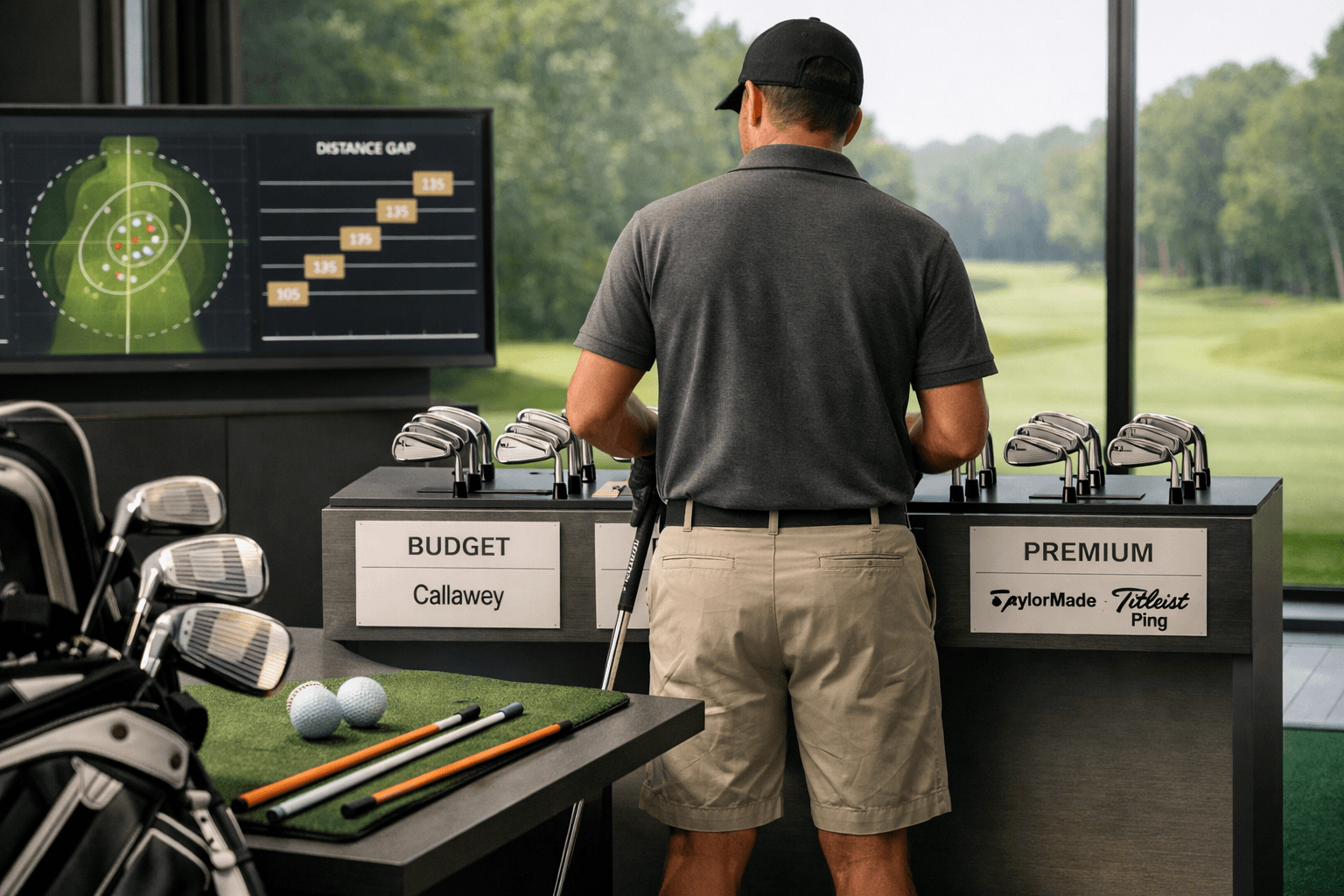
Full mid-handicap iron sets (typically 5-iron through gap wedge, 7 clubs) generally run £600-£1,100 in 2026, with premium hollow-body or players-distance models pushing toward £1,300. Combo sets sit in a similar band since you’re still buying seven-ish heads, just mixed categories.
Brand & Line Type
Category
Typical UK Price (7-club set)
Callaway Paradym-style game-improvement
Game-improvement
£750-£950
TaylorMade Stealth/Qi-style players-distance
Players-distance
£800-£1,100
Titleist T-series cavity-back
Better-player cavity-back
£900-£1,200
Mizuno JPX-style combo option
Combo set
£700-£1,000
Ping G-series game-improvement
Game-improvement
£750-£950
Don’t buy on tour usage alone. Plenty of mid handicappers pick a set because a favourite pro plays it, then find it’s built for someone striking the ball far more consistently than they currently do. Match the number on the sole to your actual miss pattern, not the name on the bag.
A proper fitting isn’t just for scratch golfers chasing half a degree of launch angle. For a mid handicapper, a one-hour fitting session, often £50-£100 and sometimes free when bundled with a purchase at a retailer like Golf Studio or American Golf, can correct lie angle and length issues that quietly cost you 2-3 shots a round. Sites like golfyet.com run through what to expect from a fitting session if you’ve never booked one and want to know the questions worth asking beforehand.
Frequently Asked Questions
Do mid handicappers really need forgiving irons, or is that just for beginners?
Yes, if your misses are still inconsistent. Forgiveness (high MOI, perimeter weighting) helps anyone who doesn’t strike the centre of the face most rounds, and that includes plenty of golfers in the 11-20 handicap range, not just complete beginners.
Is it worth getting fitted for irons if I’m not a low handicapper?
Absolutely. A basic fitting corrects lie angle and shaft length, two things that cause pulls and pushes regardless of skill, and typically costs £50-£100, often less than the price difference between two iron models.
Should I buy a combo set or a full matching set of irons?
A combo set, forgiving long irons with more workable short irons, suits most mid handicappers better than a full matching set, since your long-iron and scoring-iron needs are genuinely different in shape and feel.
The demand for street-legal golf carts is on the rise, with many consumers seeking versatile and eco-friendly transportation solutions. Starting at $12,400, the Bintelli Beyond 4PR is positioned as a high-end option in this growing…
No major has ever been played on a course that flooded a U.S. Open site the same season, but that's roughly the plot twist golf fans get with the 2026 PGA Championship. The event moves…
Titleist sells more golf balls than any other brand on the planet, and the Pro V1 is the one every pro shop assistant reaches for first when you ask "what should I be playing?" That's…