Yell “fore” on the wrong hole and you’ll get some looks. Call something a “gimme” in a stroke play tournament and you might get a penalty. Golf terms aren’t just clubhouse decoration — they’re the actual language of the rules, and mixing them up can cost you strokes or friendships.
Most beginners try to learn golf vocabulary alphabetically, which is a bit like learning a language by memorizing the dictionary. It doesn’t stick because it doesn’t match how golf actually happens. You don’t need “apron” and “albatross” filed next to each other — you need to know what people are yelling about right now, whether that’s on the tee box, in the woods, or three feet from the cup.
Key Takeaways
Golf terms group naturally by moment: tee shots, trouble shots, greenside play, and scoring.
A birdie is one under par; an eagle is two under — they’re not the same “good shot” word.
A provisional ball is played before you search for a lost ball, not after.
Ready golf speeds up casual rounds but doesn’t override the honor system in formal play.
Match play and stroke play use different scoring language — “up” and “down” mean nothing in stroke play.
Knowing five or six key terms per situation covers 90% of what you’ll hear on a normal Saturday round.
On the Tee: Words You’ll Hear Before You Even Swing
The tee box is where most golf terms first hit a beginner’s ears, usually from a playing partner ribbing you about your shot shape. Getting these down early saves you from nodding along confused for eighteen holes.
Shot Shapes: Slice, Hook, Draw, and Fade
A slice curves hard left-to-right for a right-handed golfer and is the single most common bad shot in the game — it’s caused by an open clubface relative to your swing path at impact. A hook is the opposite, curving hard right-to-left, and it’s often more destructive because it tends to run further off line. Both are considered mistakes, not shot shapes you’re trying to produce.
A draw and a fade are the controlled, intentional cousins of those two. A draw curves gently right-to-left (for a right-hander) and often adds distance because of the extra roll. A fade curves gently left-to-right and tends to land softer. Tour players talk about “playing a fade into that pin” the way you might describe parallel parking — it’s a deliberate move, not an accident.
Honor and Order of Play
The honor is the right to tee off first, and it belongs to whoever had the lowest score on the previous hole. This matters because it’s tradition and etiquette, not just a suggestion — in formal stroke play events you’ll still generally hit in honor order unless the group agrees to speed things up. That’s where ready golf comes in: it means whoever is ready hits first, regardless of score, and it’s become standard in casual rounds and even some competitive formats to cut down on pace-of-play headaches.
Here’s the correction worth remembering: ready golf is not a free pass to ignore safety or etiquette. You still don’t hit while someone’s walking to their ball, and you still don’t hit out of turn if it puts someone at risk. It’s a speed tool, not a rules override.
The Word Everyone Should Know: Fore
Fore is the shout you give when your ball might hit someone. There’s no clever backstory needed — you yell it loud, once, and you yell it fast. It’s the one word in golf where hesitation is worse than getting it wrong.
Golf carries real liability risk, and a mishit ball can genuinely hurt someone two fairways over. Treat “fore” the way you’d treat a car horn — reactive, immediate, no debate.
When Your Ball Goes Missing: Trouble-Shot Vocabulary
Nothing teaches golf terms faster than losing a ball, because suddenly you need to know exactly what to say and do within seconds. This is also where beginners make their most expensive rules mistakes.
A provisional ball is a backup ball you hit before walking forward to look for a ball you think might be lost or out of bounds. You announce it (“I’m going to play a provisional”), play it from the same spot, and if you find your original ball in play, you pick up the provisional and continue with the original at no penalty. If you can’t find the original within three minutes of starting to search, the provisional becomes your ball in play, and you’re hitting your third shot (original stroke, plus a one-stroke penalty, plus the provisional).
The mistake almost everyone makes: they think a provisional ball is something you drop after you’ve already searched and confirmed the ball is lost. It isn’t. If you’ve already walked up and started hunting, it’s too late to play a provisional — at that point, if the ball turns up lost, you’re going back to the original spot under stroke and distance, which is slower and more annoying. Playing a provisional early is the whole point; it saves you a walk back.
Out of bounds (OB) is marked by white stakes or a fence line, and hitting there costs you stroke and distance, same penalty structure as a lost ball. A lateral hazard, now more commonly called a penalty area under the modern rules, is marked with red or yellow stakes, and gives you more relief options — including dropping within two club-lengths of where the ball crossed the margin, for one penalty stroke.
Relief just means moving your ball, usually without penalty in specific situations (a cart path, a sprinkler head, ground under repair) or with a one-stroke penalty in others (unplayable lie, penalty area). Drop procedure under the current rules means holding the ball at knee height and letting it fall straight down, which replaced the old shoulder-height drop.
A provisional ball is played before searching begins, specifically to save time if the original ball turns out to be lost or out of bounds — it’s a time-saver, not a mulligan.
For a full walkthrough of how the timing works hole by hole, golfyet.com has a dedicated explainer on provisional balls that’s worth bookmarking before your next round.
On the Green: The Short-Game Language
Green-side golf terms are where casual rounds get their drama — three-footers, gimmes, and arguments about whether a putt “broke.” This vocabulary is smaller than the tee-box list but the stakes feel bigger.
The apron (sometimes called the fringe) is the strip of slightly longer grass surrounding the green, mowed shorter than the fairway but longer than the putting surface itself. It’s a transition zone, and where your ball sits on it changes your club choice completely — a chip from tight apron grass behaves differently than a pitch from the rough.
A chip is a low, running shot played close to the green, usually with more roll than air time. A pitch is a higher, softer shot meant to carry further and stop quicker. A flop shot is the show-off version of a pitch — high, soft-landing, minimal roll — and it takes real practice to pull off without embarrassing yourself.
The lie angle of a club affects how it sits on the ground at address, and it matters more than most beginners realize, especially with irons. A lie angle that’s too upright or too flat for your swing can send otherwise good shots left or right without you doing anything “wrong” mechanically.
A gimme is a putt so short that your group agrees to count it as made without you actually hitting it — standard in casual rounds, but technically not allowed in stroke play under the actual rules, where every putt has to be holed. This is one of golf’s most common etiquette-versus-rules gaps: everyone does it on a Saturday morning, nobody does it at a real tournament.
Reading the green means studying the slope and grain to predict how a putt will break. The break itself is the amount a putt curves due to slope. A putt that “lips out” caught the edge of the cup and spun away instead of dropping — one of the cruelest sounds in golf.
Equipment Words Every Beginner Mixes Up
Golf equipment vocabulary trips up beginners because so many club names sound interchangeable but aren’t. Getting this list straight will make pro shop conversations and gear reviews far less confusing.
Clubs by Job, Not Just Name
A driver is your longest club, lowest loft, built for maximum distance off the tee. Fairway woods (often numbered 3 or 5) are shorter and higher-lofted than a driver but still built for distance from the fairway or a good lie. Irons handle mid-range approach shots, numbered typically 4 through 9, with lower numbers hitting the ball farther and lower. Wedges — pitching, gap, sand, and lob — are your short-distance, high-loft scoring clubs, and most amateurs undervalue how many strokes they save around the green.
The Numbers That Actually Matter
Below is a rough guide to typical club distances for an average recreational male golfer — actual numbers vary a lot by swing speed and skill level, so treat this as a ballpark, not gospel.
Club
Typical Loft
Approx. Distance (avg. player)
Driver
9-10.5°
200-230 yards
5-wood
18°
180-195 yards
7-iron
34°
130-145 yards
Pitching wedge
46°
100-110 yards
Sand wedge
56°
60-80 yards
Lie angle, mentioned earlier for its impact on shot direction, is set at the factory but can be bent by a qualified club fitter for a few dollars per degree — worth doing if you’re consistently missing the same direction with irons.
One more common mix-up: a hybrid is a cross between an iron and a fairway wood, easier to hit from rough than a long iron, and most mid-to-high handicap players are better off carrying two or three hybrids instead of long irons entirely.
Scoring Terms: Why Birdie and Eagle Aren’t the Same Thing
This is the section that trips up more casual fans than any other, because TV commentary throws these words around fast and beginners assume they’re all just synonyms for “good shot.” They’re not — they’re precise, numeric terms tied directly to par.
Par is the number of strokes a skilled golfer is expected to need on a hole, usually 3, 4, or 5. Every scoring term is measured against that number, which is why the terms are so specific.
Eagle — two strokes under par (a 3 on a par-5, for example). This is rare for most amateurs and a big deal even for tour pros.
Birdie — one stroke under par. This is the everyday “good hole” for a decent amateur and the bread-and-butter scoring term on any broadcast.
Par — meeting the expected score exactly. Solid, unremarkable, and the actual target for most rounds.
Bogey — one stroke over par. Extremely common even for good players; nothing to be embarrassed about.
Double bogey — two strokes over par, and the point where most weekend golfers start rounding up their scorecards.
Albatross (double eagle) — three strokes under par, so rare that many golfers never see one in their lifetime, amateur or pro.
The correction worth hammering home: a birdie and an eagle are not interchangeable “nice shot” words — an eagle is specifically two better than par, and mixing them up on the course marks you as new pretty fast. If your buddy says “nice eagle” after your birdie putt, they’re either joking or they don’t know the difference either.
Handicap deserves its own quick mention here since it’s tangled up with scoring. A handicap is a number representing your typical scoring ability relative to par, calculated from your recent rounds, and it lets golfers of different skill levels compete fairly by adjusting strokes. A 15-handicap golfer gets to subtract 15 strokes from their gross score to get a “net” score comparable to a scratch (0-handicap) player.
Match Play vs. Stroke Play: The Words Don’t Transfer
Stroke play counts every single stroke across the whole round (or tournament) and the lowest total wins — this is what you see at most professional events, including the Masters and the U.S. Open. Match play is a hole-by-hole contest between two players or teams, where you win, lose, or tie each individual hole, and the overall total score barely matters.
This distinction matters because the vocabulary genuinely doesn’t cross over, and using stroke-play thinking in a match-play format will confuse you fast.
Match Play’s Own Language
In match play, being “2 up” means you’ve won two more holes than your opponent, not that you’re two strokes ahead. A match that ends “3 and 2” means one side was three holes ahead with only two holes left to play, so the match ended early because it was mathematically decided. All square means the match is tied. A concession happens when a player picks up an opponent’s ball and says it’s good — the putt counts as holed even though it wasn’t struck, which is legal in match play but not in stroke play (that’s the gimme distinction again, but formalized).
Stroke Play’s Own Language
In stroke play, there’s no such thing as conceding a hole or putt — every stroke on every hole counts toward your total, full stop. Terms like “up” and “down” simply don’t apply; instead you’ll hear “under par” or “over par” for the whole round, like “4-under through 14.” The Ryder Cup actually uses match play format specifically because it creates more dramatic, momentum-based golf than a straight stroke-play leaderboard would — which is part of why casual fans sometimes find it confusing if they’re used to regular tour events.
Getting this distinction backwards is an easy trap: a beginner watching the Ryder Cup for the first time might wonder why someone celebrates wildly after “only” being 2 up with three holes left, when in stroke play terms that lead would look almost meaningless.
Slang and Nicknames You’ll Actually Hear at the Course
Beyond the official rulebook vocabulary, golf has a whole layer of slang that’s regional, informal, and occasionally makes zero sense until someone explains it. This is the stuff you won’t find in an official rules document but will hear constantly on a Saturday morning tee sheet.
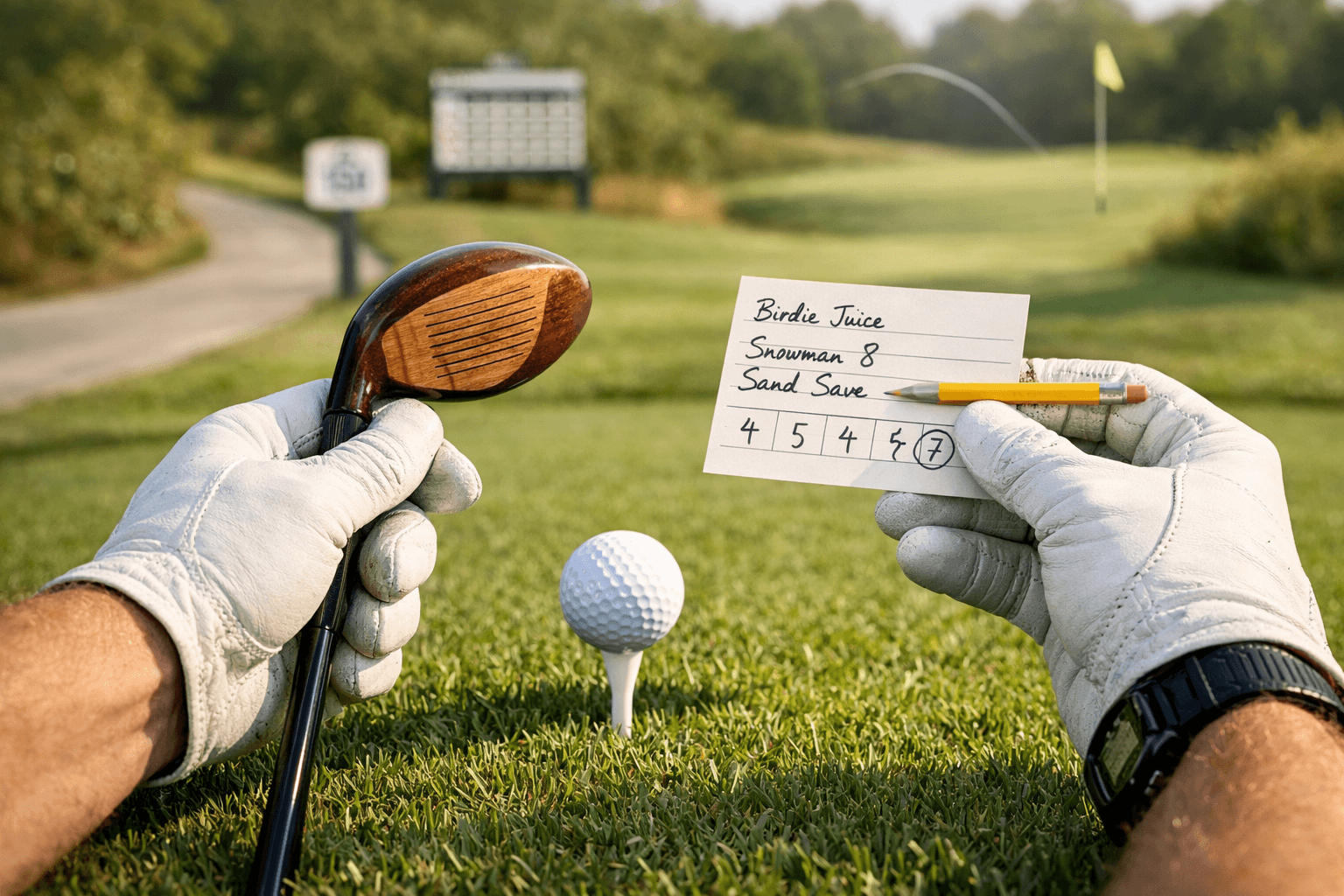
A mulligan is an unofficial do-over shot, usually only allowed on the first tee in casual rounds among friends, and it has zero standing in any actual rules format. A snowman is slang for an 8 on a hole, because the number looks like two stacked circles. A Texas wedge is when you putt from off the green instead of chipping, a perfectly sound strategy on firm, dry conditions.
The dance floor is slang for the green itself — “you’re on the dance floor” means your approach shot found the putting surface. A worm burner is a shot hit so low it barely clears the grass, usually accompanied by groans from your group. In the leather refers to a putt close enough to the hole that it’s inside the length of the grip on your putter, traditionally treated as a gimme in casual rounds (though again, not in real stroke play).
A shank is a mishit off the hosel of the club that sends the ball sharply and unpredictably to the right (for a right-hander), widely considered one of the most feared words in golf — some golfers won’t even say it out loud, superstitiously calling it “the S-word” instead. A chunk or chili-dip is hitting the ground before the ball, usually on a chip or pitch, sending the ball a few embarrassing feet forward.
None of this slang shows up in the official Rules of Golf published by the USGA and R&A, but you’ll hear it more often on an actual course than half the formal terminology combined. Knowing both layers — official and slang — is really what separates someone who sounds like they belong out there from someone still figuring out which end of the putter to hold.
Frequently Asked Questions
What’s the difference between a bogey and a double bogey?
A bogey is one stroke over par on a hole; a double bogey is two strokes over. On a par-4, a bogey is a 5 and a double bogey is a 6 — the difference is exactly one extra stroke.
Is a provisional ball the same as taking a mulligan?
No. A provisional ball is a legal rules procedure played before searching for a potentially lost ball, with no penalty if you find the original. A mulligan is an unofficial do-over with zero standing in actual rules and no legal status in any real competition.
Does ready golf mean I can ignore the honor system entirely?
Not entirely. Ready golf lets whoever’s prepared hit first to keep pace, but it’s a courtesy speed measure for casual rounds, not a blanket override — safety and basic etiquette (not hitting into someone’s line, not rushing a nervous player) still apply.
Why do match play and stroke play scores sound so different?
Match play tracks holes won (“2 up,” “3 and 2”), while stroke play tracks total strokes (“4-under par”). They’re separate scoring systems entirely, so a big match play lead and a big stroke play lead aren’t measuring the same thing at all.
Golf, a sport steeped in tradition, has a rich history that spans centuries. The game has evolved significantly over time, shaped by various factors that have influenced its development.The origins of golf in Scotland laid…
A 90 mph swing speed hits a driver about 220 to 230 yards. A 105 mph swing speed clears 280. That gap explains more about your golf game than your age or gender ever will,…
Golfers of all skill levels encounter the lost ball rule frequently on the course. According to the Rules of Golf, a ball is deemed lost if not found within three minutes after search begins. This…