Scoring for Ryder Cup: Understanding the Format and Rules
13 July, 2026Logan Hart0 Comments1 category
The Ryder Cup doesn’t care how many strokes you take. That’s the first thing to understand about scoring for ryder cup matches — it’s not the tournament you’re used to watching on Sundays. No leaderboard with running totals. No cutting players after two days. Just hole-by-hole competition where winning a hole is all that matters, and a single putt can swing a match completely.
If you’ve watched the Ryder Cup and felt confused about why a player could make a double bogey and still be “all square,” you’re not alone. The format runs on match play rules, which work differently from the stroke play format used in the Masters or the U.S. Open.
Key Takeaways
Ryder Cup uses match play — total strokes never matter
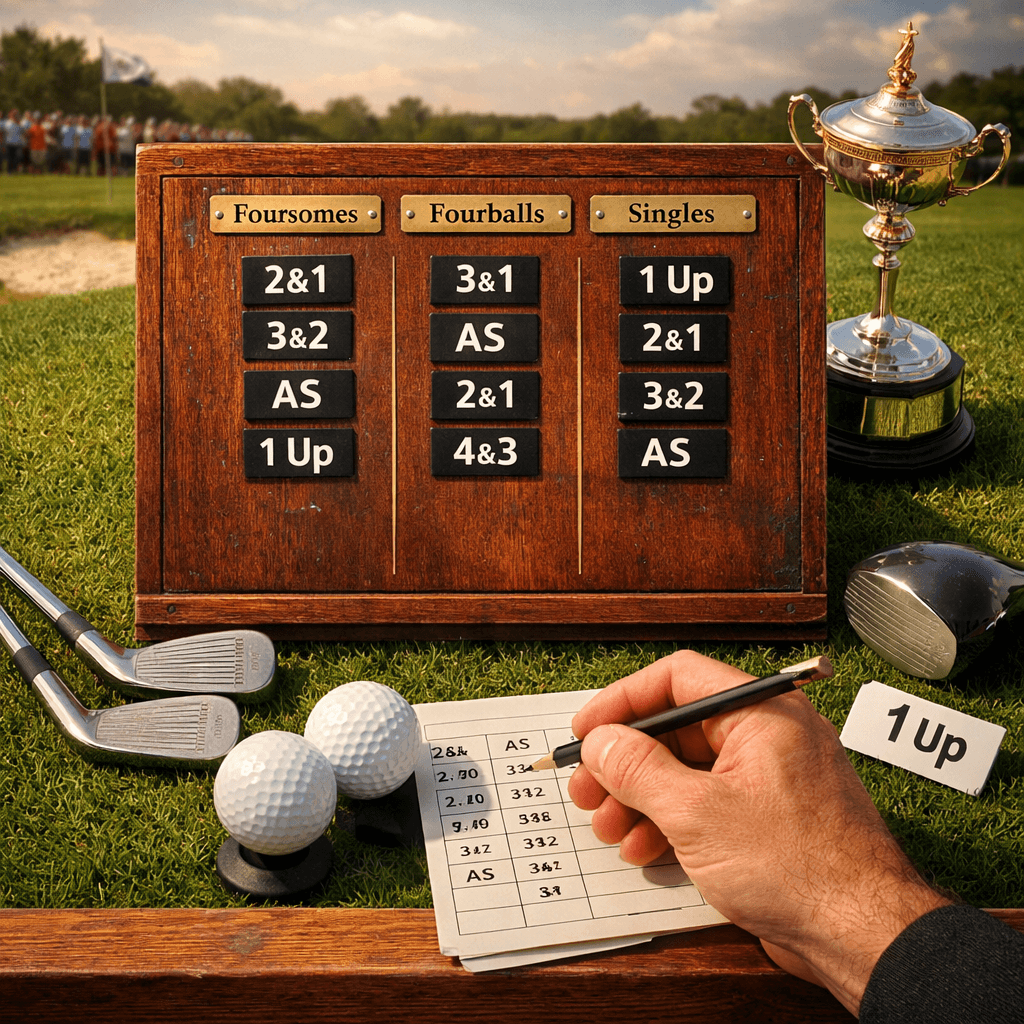
Three formats: foursomes, four-ball, and singles
28 total points available; 14.5 wins the Cup
Sunday singles alone offers 12 of 28 points
A halved match earns each team 0.5 points
At 14-14, the defending champion retains the Cup
The Ryder Cup Runs on Match Play, Not Stroke Play
Match play scoring ignores your total stroke count. Each hole is its own contest. Win the hole, you go 1 up. Lose it, you go 1 down. Tie it, you stay where you are. The match ends the moment one player (or pair) leads by more holes than are left to play — that’s called winning “3&2” or “4&3,” for example.
That notation is worth decoding. “3&2” means the winning side is 3 holes ahead with only 2 holes remaining, so the trailing side can’t catch up. The match stops right there, on hole 16. A “4&3” finish ends on hole 15. The largest possible margin in an 18-hole match is “10&8,” which ends on hole 10.
Match play is defined as a form of play where the game is played hole by hole, and a side wins a hole by completing it in fewer strokes than the opponent. — USGA Rules of Golf
One practical consequence: a player can make a double bogey on a hole and lose exactly as much ground as if they’d made a triple. The hole is gone either way. That’s a real shift from stroke play thinking, and it takes adjustment.
The Ryder Cup has used match play since its first edition in 1927. That history matters because it shapes everything about how the event feels on television. Stroke play rewards grinding consistency over 72 holes; match play rewards momentum, nerve, and the ability to flip a match with a single birdie putt at exactly the right moment.
Three Formats, One Scoreboard: How Each Session Works
The Ryder Cup uses three distinct formats across its three days of competition. Each session contributes points to a shared scoreboard, and understanding the difference between them makes the whole event easier to follow.
Format
Players Per Side
Balls in Play
Points Available Per Match
Foursomes
2
1
1
Four-Ball
2
2
1
Singles
1
1
1
Every match, regardless of format, is worth exactly 1 point.
Foursomes: One Ball, Two Players Alternating Shots
Foursomes (also called alternate shot) puts two players on the same team sharing a single ball. One player tees off on odd-numbered holes, the other tees off on even-numbered holes, and they alternate every shot in between. So if Player A hits the drive, Player B hits the approach, Player A hits the chip, and so on.
This is the most demanding team format in golf. A bad shot from one partner immediately puts pressure on the other. There’s no safety net of a second ball. Captains pick pairings carefully here — players need compatible games and strong communication.
Four-Ball: Each Player Hits Their Own Ball
Four-ball puts two players against two players, but each of the four hits their own ball throughout the hole. The better score from each pair counts. So if one partner makes a mess of a hole, the other can save the point with a birdie.
This format tends to produce more aggressive play. Players take risks they wouldn’t take in foursomes because their partner can bail them out. A 2-under score on a hole isn’t unusual in four-ball, which makes it exciting to watch.
Singles: Twelve Head-to-Head Matches
Sunday’s singles session sends all 12 players from each team out in individual matches — one American against one European, 12 times over. With 12 points available, singles day can completely reverse a deficit built over the first two days. The 1999 Ryder Cup at Brookline is the clearest example: the U.S. trailed 10-6 heading into Sunday and won 8.5 of the 12 singles points to take the cup.
How Points Are Earned Hole by Hole
In match play, you earn a point for the match, not for individual holes. Holes are the currency you use to build a lead, but the only thing that goes on the scoreboard is whether you win, lose, or halve the overall match.
Winning a Hole vs. Winning a Match
You win a hole by completing it in fewer strokes than your opponent. Win enough holes and you win the match. The match ends early if your lead becomes mathematically insurmountable. If you’re 3 holes ahead with only 2 left to play, the match is over. You win “3&2.”
The score resets to zero at the start of every match. A team that lost 5&4 in the morning session starts the afternoon at all square, no deficit carried over.
What a Halved Match Actually Means for the Scoreboard
A halved match (where both sides finish the 18 holes tied) does not result in zero points for either team. Each side earns half a point (0.5). Over a full Ryder Cup, those halves add up. A session where one team wins three matches and halves two is worth 4 points, not 3.
This trips up a lot of casual viewers who assume a tie means nothing changes. In a tight Ryder Cup, a string of halved matches can be exactly what the trailing team needs to stay within striking distance.
The Full 28-Point Structure Across Three Days
The current Ryder Cup format spreads 28 total points across three days. Friday and Saturday each offer 8 points, and Sunday’s singles session accounts for the remaining 12. Reaching 14.5 points wins the cup outright.
That’s 8 matches on Friday, 8 on Saturday, and 12 on Sunday. 28 total.
This structure hasn’t always looked this way. The Ryder Cup expanded to its current 28-point format in 1979 when Europe replaced Great Britain and Ireland as the U.S. opponent, and the event went through several format adjustments before settling on the current setup in 1979. The foursomes-then-four-ball daily pairing on Friday and Saturday is a deliberate choice that tests different skills in the same day.
One practical consequence of this structure: a team can build a strong lead over the first two days and still lose. In 2012 at Medinah Country Club, Europe trailed 10-6 heading into Sunday, needing 8 points from 12 singles matches to win. They got exactly that and won the cup. With 12 points on the line in singles, no lead under 14 points is safe before Sunday is finished.
Each halved match still contributes 0.5 to each side, so the running total can include decimals like 14.5 or 11.5 at any point during the event.
Match Play Psychology: Why Losing Badly Still Leaves You in the Match
Losing a hole 6 down in strokes costs you exactly the same as losing it by one stroke — just one hole. That’s the core psychological difference in match play. A player can make a triple bogey, fall 3 down in the match, and still win because the next 15 holes start fresh.
This makes momentum the real currency of match play. A run of three or four consecutive holes won can flip a match from 3 down to 1 up in under an hour. No other format in golf allows that kind of swing without any change to the overall score card.
For casual viewers used to stroke play, this feels wrong. A player who shoots 4-over through 10 holes in a regular tournament is effectively done. In match play, that same player could be 2 up if their opponent happened to be 5-over. The strokes don’t travel — only the hole results do.
This is also why Ryder Cup matches that look lopsided on television can close fast. A team down 3-0 in matches on the board can win all three if the leads collapse hole by hole.
How Ryder Cup Pairings Get Decided
The two captains control pairings completely, and they submit them without seeing the other side’s choices first. For Friday and Saturday sessions, each captain names four two-man pairings per session. Those names go to officials simultaneously, so neither captain knows who they’re matching up against until both lists are revealed.
That blind submission creates real tactical risk. A captain who loads his best pairing into the first match of the morning might find they’re facing the opposing team’s weakest duo, or their strongest. There’s no adjustment window. Once the lists are handed in, the matchups are locked.
The captain’s pairing decisions are widely considered the single biggest tactical lever in the event. A captain might pair a long hitter with a precise iron player for foursomes, then split them up in four-ball to maximize the number of players contributing points.
In practice, captains often rest one or two players per session across Friday and Saturday, which means not every player appears in all four team sessions. A 12-man roster playing four sessions of four matches means 16 pairing slots total. Some players will sit out at least once, and captains choose who gets that rest strategically.
Captain’s picks (the discretionary selections that supplement automatic qualifiers) exist partly to give captains flexibility in building pairings. In the current format, each captain selects 6 automatic qualifiers and 6 picks, though the exact split has varied by era, so check the most recent team announcements for the current breakdown.
Those picks often go to players with strong partnership chemistry rather than simply the next-best finishers in qualifying. A veteran who plays well alongside a younger teammate can be more valuable in team formats than a higher-ranked player who pairs awkwardly.
For Sunday singles, captains again submit their lineup order independently and simultaneously. The order matters: putting your strongest players early can build momentum, while saving them for the back end protects against a slow start.
The 2023 Ryder Cup at Marco Simone showed how dramatically order strategy can swing a result. Europe’s captaincy stacked experience at the top of the singles draw, building an early lead that proved difficult for the United States to overcome across the back nine of the order.
How a Team Wins — and What Happens at 14-14
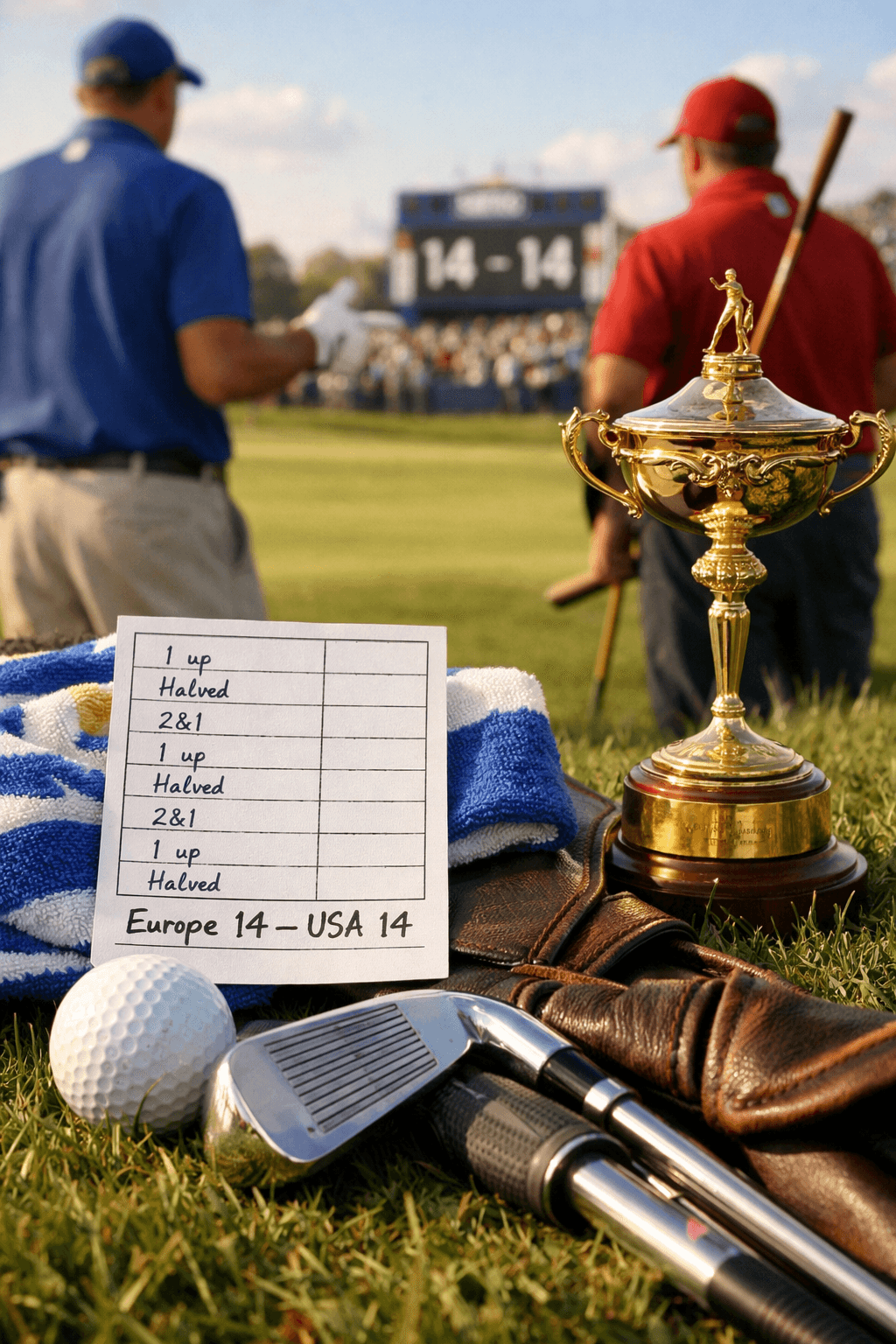
The first team to reach 14.5 points wins the Ryder Cup outright. With 28 total points available, 14.5 is the number that can’t be matched. If the event ends at exactly 14-14, the defending champion keeps the cup. They don’t have to win it back.
The rule that a tie allows the holder to retain the Ryder Cup has applied since the modern format was established, making a 14-14 result a functional victory for the defending side.
This retention rule catches a lot of casual fans off guard. Europe retained the cup at The 2018 Ryder Cup in Paris after winning outright, so retention wasn’t a factor. But in a close event, the trailing team needs 14.5, not just 14. That half-point distinction has real tactical weight on Sunday afternoon.
The last time the retention rule actually mattered in a meaningful way was 1969 at Royal Birkdale, when the United States held the cup after finishing 16-16 under the old format. It’s a rare outcome, but Sunday singles can compress quickly, and a two-point lead can evaporate across 12 simultaneous matches.
One practical consequence: a team leading 14-10 going into the final matches can clinch before all singles are finished. Matches still in progress get halved by agreement once the result is decided.
That early clinch scenario happened at the 2004 Ryder Cup in Oakland Hills, where Europe reached 14.5 before the final singles matches concluded. Players on the course at that moment typically finish out of respect, but the official result is already locked. Captains sometimes choose to concede remaining matches entirely rather than play on with nothing at stake.
Frequently Asked Questions
Does the Ryder Cup use stroke play at any point?
No. The entire Ryder Cup, covering foursomes, four-ball, and singles, is match play. Total strokes are never counted for scoring purposes. Only hole results determine who wins each match, and each match result contributes points to the overall tally.
Can a Ryder Cup match end before the 18th hole?
Yes, and it happens regularly. A match ends as soon as one side’s lead is larger than the number of holes remaining. If a player is 3 up with 2 holes left, the match ends “3&2” because the trailing side can’t catch up mathematically. Finishing early is normal, not a forfeit.
What happens if a singles match is halved?
Each team earns 0.5 points. A halved singles match on Sunday is not a wasted result. In a tight Ryder Cup, those half-points can be the difference between winning outright at 14.5 and forcing a retention scenario at 14-14. Half-points appear throughout the final scoreboard.
How many times has the Ryder Cup ended in a 14-14 tie?
It has happened twice: in 1969 at Royal Birkdale and in 1989 at The Belfry. Both times, the defending champion retained the cup. If you want a deeper look at match play formats and how scoring works across different golf competitions, golfyet.com covers the rules side of the game in plain language.
The personal transportation landscape is undergoing a significant shift, with vehicles like the Tomberlin E-Merge GT redefining the boundaries between golf carts and street-legal automobiles. As communities increasingly adopt Low-Speed Vehicles (LSVs) for neighborhood transportation,…
Shadow Creek Golf Course sits in North Las Vegas, not on the Strip, and it's one of the most restricted golf experiences in the United States. You can't just call and book a round. Access…
Understanding the intricacies of Rule 16 is crucial for golfers to navigate the course effectively. This rule covers situations where a player can take free relief due to abnormal course conditions or dangerous animal situations.When…