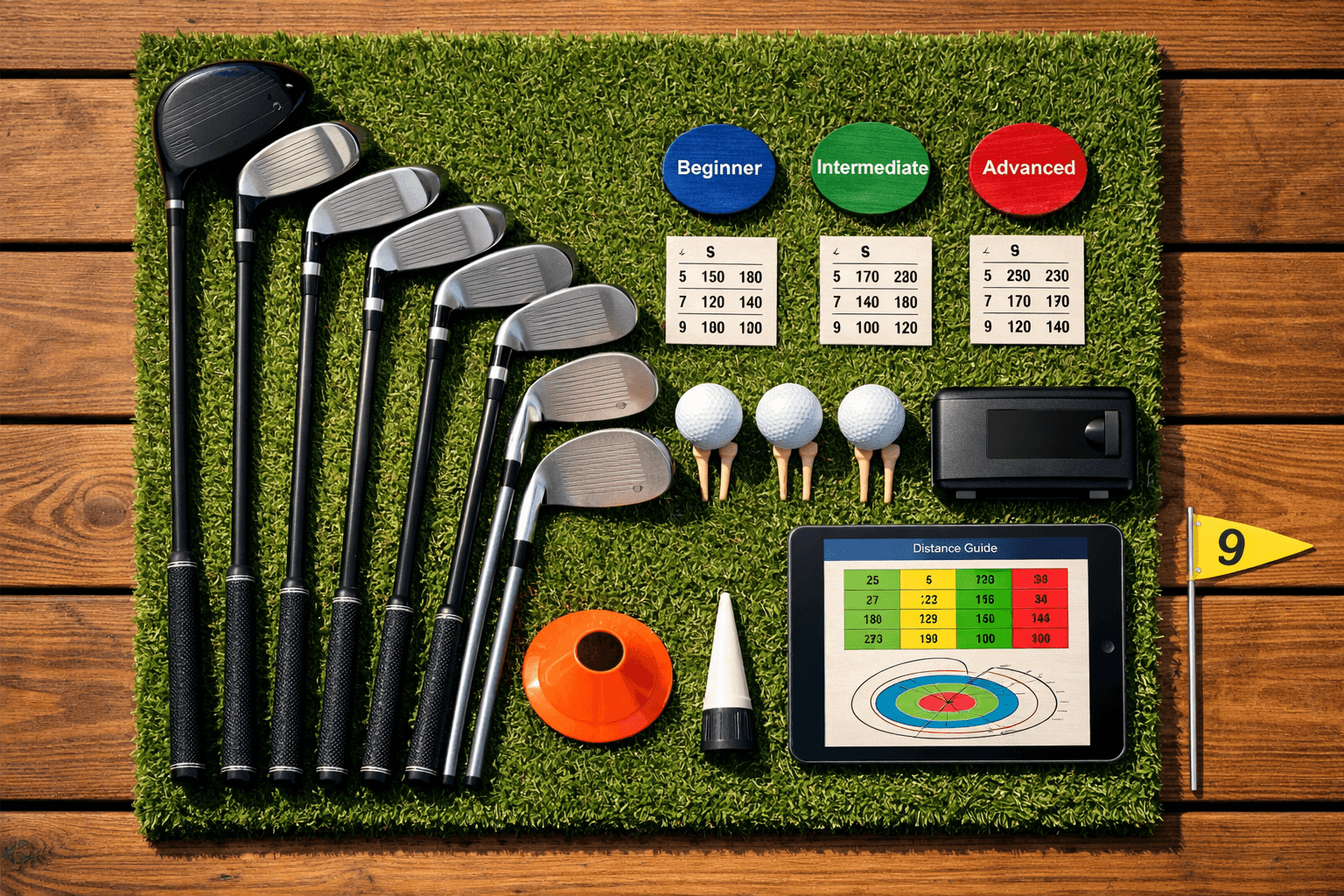
Most beginners grab a club based on gut feeling and hope for the best. Understanding golf club number and distance changes that completely. Lower numbers hit the ball farther, higher numbers hit it shorter. Once that clicks, club selection starts making sense.
This guide anchors distances to realistic amateur ranges, not tour pro numbers. You’ll get actual yardage expectations by skill level so you can make smarter decisions on the course, not just admire numbers you’ll never hit.
Key Takeaways
Lower club number = less loft = more distance
Beginners average 150–180 yards with a driver
Swing speed matters more than equipment upgrades
Replace 3- and 4-irons with hybrids immediately
Plan for your average carry distance, not your best
Club up when in doubt — long misses beat short ones
Golf Club Numbers Mean Distance: Lower Goes Farther
Lower club numbers mean longer distance. That’s the core rule of the golf club numbering system. A 3-iron hits farther than a 7-iron. A 3-wood hits farther than a 5-wood. The number goes up, the distance comes down.
Why? Lower-numbered clubs have a flatter loft angle, which is the angle of the clubface relative to vertical. Less loft launches the ball lower and farther. Higher-numbered clubs have more loft, which sends the ball higher and shorter, giving you more control near the green.
Loft is the primary design variable that determines a club’s distance — lower loft produces lower launch angle and greater carry distance, while higher loft increases trajectory and reduces overall yardage. (PGA of America, Club Fitting Fundamentals)
Realistic Distance Ranges by Club Number and Skill Level
Distance varies more by swing speed and skill level than most beginners expect. The numbers on tour TV are not your numbers. Anchoring your club selection to your actual distances is what separates smart course management from wishful thinking.
Club
Beginner (yds)
Intermediate (yds)
Advanced (yds)
Driver
150–180
200–230
250–280
3-Wood
125–155
170–200
215–240
5-Wood
115–140
155–185
200–225
4-Iron
110–130
150–170
185–210
5-Iron
100–120
140–160
175–200
6-Iron
90–110
130–150
165–185
7-Iron
80–100
120–140
155–175
8-Iron
70–90
110–130
140–160
9-Iron
60–80
95–115
125–145
Pitching Wedge
50–70
80–100
110–130
How Beginner, Intermediate, and Advanced Distances Actually Differ
A beginner typically swings a driver at 70–80 mph of clubhead speed, which produces carry distances in the 150–180 yard range. An intermediate player swings around 85–95 mph and gains roughly 50 yards on that same club. Advanced amateurs hitting 100+ mph approach the 250-yard mark.
The gap between skill tiers is widest with long clubs and narrows with short irons. A beginner and an advanced player might be only 30–40 yards apart with a 9-iron, but 80–100 yards apart with a driver. That’s why beginners often play shorter courses or forward tees. The yardage difference is real.
Men vs. Women Average Distances by Club
Women’s distances run roughly 20–30% shorter than men’s across most clubs, driven primarily by average swing speed differences. A woman with an intermediate swing might carry a 7-iron around 100–115 yards, where a man at the same skill level carries it 120–140 yards.
These aren’t ability gaps. They’re physics. Women’s clubs are built with more loft and lighter shafts to compensate, which is why using clubs designed for your swing speed matters more than the number on the clubhead.
Irons: What to Expect From a 3-Iron Through a 9-Iron
Irons are the most varied group in your bag. They range from the long, low-lofted 3-iron down to the high-lofted 9-iron, and each one has a distinct purpose. Most recreational golfers carry a 4- or 5-iron through 9-iron, skipping the hardest-to-hit long irons entirely.
Long Irons (3, 4, 5): Why Most Amateurs Should Avoid Them
A 3-iron has roughly 20–21 degrees of loft. That’s very little, which means you need a fast, precise swing to get the ball airborne consistently. Most amateur golfers don’t generate enough clubhead speed to make a 3-iron work reliably — the ball stays low, skips off the turf, and goes nowhere useful.
Swap your 3- and 4-iron for a hybrid instead. Hybrids cover the same distance range with a more forgiving clubhead design. Even many tour players carry hybrids over long irons now. If you’re shooting over 90 regularly, the 5-iron is probably your longest iron worth keeping.
Mid and Short Irons (6, 7, 8, 9): Your Most-Used Clubs
The 6-iron through 9-iron are where most recreational rounds are actually played. These clubs have enough loft (roughly 26–42 degrees depending on the manufacturer) to get the ball in the air without a perfect strike. A mishit 7-iron still goes somewhere useful. A mishit 3-iron usually doesn’t.
The 7-iron is often called the benchmark club for a reason — it’s forgiving, mid-range in distance, and a reliable gauge of your current ball-striking ability. If you want to track your improvement over a season, hit 20 balls with your 7-iron and measure the average carry. That number tells you more about your game than any single round score.
Woods, Drivers, and Hybrids: The Long Game Numbers
The driver, fairway woods, and hybrids handle the longest shots on the course. These clubs share one thing: they’re built to cover ground, not finesse a landing spot. Knowing what each one actually does for an average golfer is the difference between smart tee decisions and wasted strokes.
Club
Loft Range
Beginner (yds)
Intermediate (yds)
Advanced (yds)
Driver (1-Wood)
9–12°
150–180
200–230
250–280
3-Wood
15–18°
125–155
170–200
215–240
5-Wood
20–22°
115–140
155–185
200–225
3-Hybrid
19–21°
120–145
165–190
195–215
4-Hybrid
22–25°
110–130
150–170
180–205
5-Hybrid
26–28°
100–120
140–160
170–190
Driver and Fairway Woods: What Average Golfers Actually Hit
The driver is the longest club in the bag, typically 45 inches for men’s off-the-shelf models. Most recreational male golfers carry it 200–230 yards, not the 280+ you see on TV. Women at an intermediate level average closer to 150–175 yards of carry with a driver.
A 3-wood is your second-longest option and more forgiving off tight fairway lies. Many golfers hit their 3-wood more consistently than their driver because the shorter shaft makes contact easier to control. If you’re struggling off the tee, hitting a 3-wood for accuracy often saves more strokes than chasing driver distance.
The 5-wood fills the gap between a 3-wood and a hybrid, and it’s underrated. Golfers who carry one typically use it for long par-3s or second shots on par-5s where a hybrid feels too short and a 3-wood too aggressive.
Hybrids Replace Long Irons for a Reason
A hybrid combines the rounded sole of a fairway wood with an iron-length shaft, making it far easier to launch from rough, fairway, or tight lies. The 3-hybrid and 4-hybrid cover roughly the same distances as a 3-iron and 4-iron, but with a higher launch angle and a bigger sweet spot.
Callaway, TaylorMade, and Titleist all offer hybrids in the $150–$250 range new, and used models regularly sell for under $60. For most golfers shooting in the 90s or above, swapping long irons for hybrids is the single most practical equipment change available.
Wedges Are Not All the Same Distance
Wedges cover the last 130 yards into the green, but they’re not interchangeable. There are four distinct types, each with a different loft angle and a different job. Treating them all as “the short club” is how you leave yourself with awkward in-between yardages.
Pitching, Gap, Sand, and Lob Wedge Yardages
Pitching wedge (44–48°): 80–130 yards depending on skill level
Gap wedge (50–54°): 70–110 yards, filling the distance hole between pitching and sand wedges
Sand wedge (54–58°): 60–90 yards, designed with extra bounce to glide through bunker sand
Lob wedge (58–64°): 40–70 yards, used for high, soft shots over obstacles or tight pin positions
Most beginner sets include only a pitching wedge. Adding a gap wedge around 52° is the next step. It plugs a yardage gap that otherwise forces awkward half-swings.
When to Pull Which Wedge
Match the wedge to the distance, not the situation. If you’re 95 yards out on a flat lie, that’s a gap wedge at a normal swing, not a pitching wedge choked down. Save the lob wedge for shots that need height fast. A pitch over a bunker lip is the classic example. Pulling a 64° lob wedge from 100 yards is a common mistake that costs strokes.
Swing Speed Is the Real Distance Engine
Club number sets the ceiling — swing speed determines where you actually land under it. Two golfers can swing the same 7-iron and finish 40 yards apart. **Your clubhead speed is the primary variable controlling how far the ball goes**, and it’s worth understanding before you chase equipment upgrades.
Here’s how swing speed connects to distance outcomes:
Below 70 mph (driver): Expect carry distances under 160 yards with a driver. Focus on contact quality before worrying about distance.
70–85 mph: The beginner-to-intermediate range. A driver carries 160–210 yards. Shaft flex should be regular or senior to match this speed.
85–95 mph: Mid-amateur range. A driver carries 210–240 yards. Regular to stiff shafts work here depending on tempo.
Above 105 mph: Extra-stiff or tour-stiff shafts. Distances exceed 270 yards with a driver. This is where launch monitor fitting becomes worth the cost.
A basic swing speed measurement takes about five minutes at any golf retailer with a launch monitor — Titleist and Callaway fitting centers offer this for free. Knowing your number takes the guesswork out of shaft selection and sets realistic distance expectations across every club in your bag.
How to Pick the Right Club for Any Yardage on the Course
Start with your known carry distance for each club, not the maximum you’ve ever hit. Know your average, not your best. If your 7-iron carries 140 yards on a good swing but 125 on a typical one, plan for 125. Most recreational golfers consistently overestimate by 10–15 yards and come up short of the green.
On the course, account for two variables beyond yardage: elevation change and wind. A shot playing 10 feet uphill needs roughly one extra club (so a 6-iron instead of a 7-iron). A 15 mph headwind can cost you 10–20 yards of carry depending on your ball flight trajectory — higher ball flights lose more distance into the wind.
Club up when in doubt. A shot that flies past the green is usually easier to chip from than a short-sided bunker or a steep front slope. Aggressive short-game play from behind the green beats scrambling from the front most of the time.
A simple system: before each approach, pick your target yardage, subtract any elevation adjustment, then match that number to your average carry chart. Golfyet.com has a beginner-friendly club selection guide if you want a printable version to keep in your bag during early rounds.
Frequently Asked Questions
What does the number on a golf club actually tell you?
The number indicates loft. Lower numbers mean less loft and more distance; higher numbers mean more loft and shorter distance. A 3-iron hits farther than a 9-iron because it has a shallower face angle, not because of shaft length alone.
How far should a beginner expect to hit a 7-iron?
Most beginners carry a 7-iron 100–130 yards. That’s a realistic range, not a failure. Even mid-handicap golfers average around 130–150 yards with the same club. Distance grows as contact consistency improves, not just swing effort.
Is it okay to skip certain club numbers in my bag?
Yes. You carry up to 14 clubs under the rules, but nothing says you need every number. Many golfers drop their 3- and 4-irons entirely and replace them with hybrids. Filling distance gaps matters more than having a sequential set.
Does a more expensive club add distance?
Marginally, and only if the specs match your swing speed. A $500 driver fitted to the wrong shaft flex won’t outperform a $150 driver fitted correctly. Equipment helps, but a repeatable swing produces more consistent distance gains than any upgrade.
Your elbow aches after every range session, and your shots still leak right. That's not a coincidence. Golf elbows — sore, achy joints from a faulty swing — are usually the same root problem as…
There are more than 40 recognised crazy golf courses stretched across the UK, from the Land's End coastline to Aberdeenshire. If you're crazy about golf and the mini-putt version of it in equal measure, that…
Here's the part nobody tells you at the driving range: your swing doesn't matter yet. If your grip and stance are off before you take the club back, no amount of "swing mechanics" advice will…