You shot 82 last Saturday, your best round of the year, and your Handicap Index barely moved. That’s not a glitch in the GHIN app. That’s the soft cap quietly doing its job, and it’s the part most explainers skip entirely.
Understanding how are golf handicap calculated matters if you’ve ever squinted at your GHIN profile and wondered why the number on your phone doesn’t match your gut feeling about your game. The math itself isn’t that scary. The rules that limit how fast it moves are the part that actually affects you round to round.
Key Takeaways
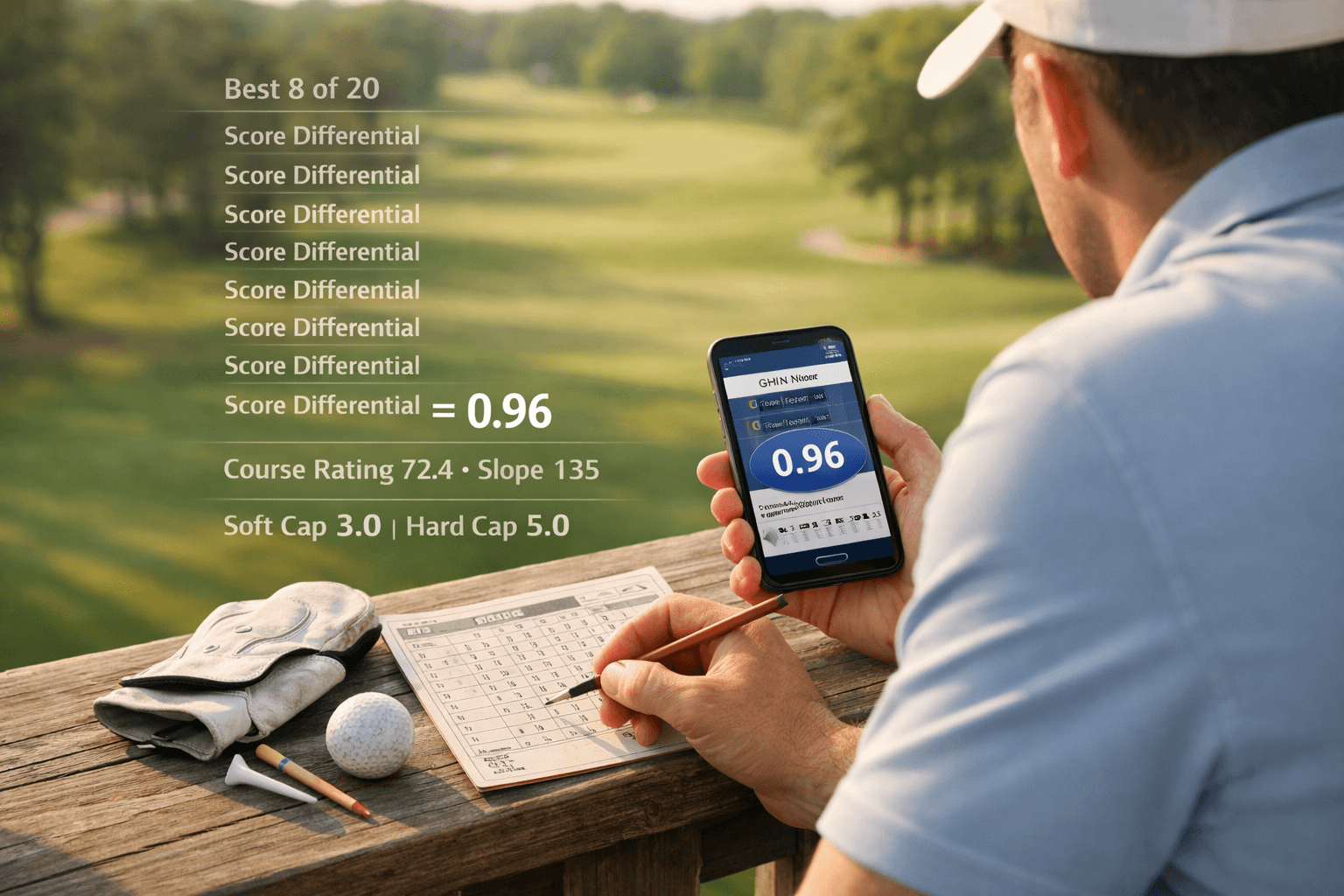
Your Index uses the best 8 of your last 20 Score Differentials, not an average of all 20.
The final number gets multiplied by 96% before it becomes your Handicap Index.
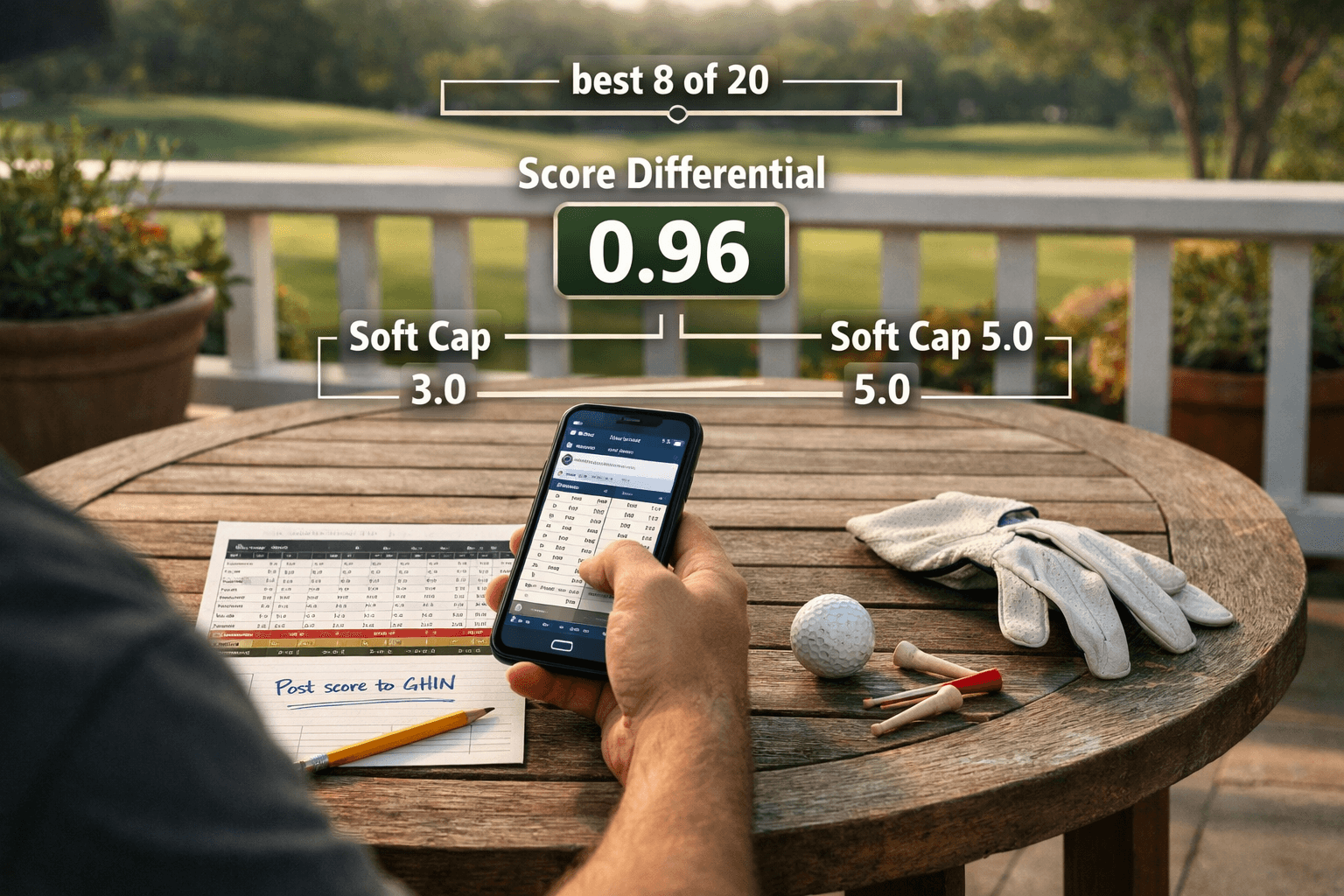
A soft cap slows Index increases past 3.0 strokes; a hard cap blocks anything over 5.0.
Course Handicap changes by tee and course — your Index does not.
You only need 54 holes (three 18-hole rounds, or combinations) to get a starter Index.
The Short Answer: How Golf Handicaps Actually Get Calculated
Your Handicap Index is the average of your best 8 Score Differentials out of your most recent 20 rounds, multiplied by 0.96. Each Score Differential accounts for the course’s difficulty, not just your raw score, which is why an 88 at a hard course can beat an 82 at an easy one.
This system is called the World Handicap System (WHS), and it’s been the standard in the US since 2020, run through the USGA and GHIN. Before that, golfers dealt with a patchwork of regional systems that didn’t talk to each other. Now a golfer in Ohio and a golfer in Arizona are measured the same way, which matters if you ever play in an outing or member-guest event outside your home club.
Here’s the part that trips people up: the system doesn’t care about your average round. It cares about your good rounds, filtered through course difficulty math, then slightly discounted. That last step — the discount — is where a lot of the confusion about “why didn’t my handicap drop” actually lives, and we’ll get there.
A Handicap Index is a measure of a player’s demonstrated ability calculated as the average of the best 8 Score Differentials from the player’s most recent 20 scores, according to the USGA’s World Handicap System rules.
Three ideas drive everything else in this article: the Score Differential formula, the best-8-of-20 selection, and the 96% multiplier. Get those three straight and the rest — Course Handicap, PCC, caps — makes a lot more sense.
Why Not Just Average All 20 Rounds?
Because golf rounds are noisy. You’ll have blowup holes, a three-putt streak, a bad wind day. Averaging all 20 would punish you for having an off week even though your scoring potential — what you’re actually capable of — hasn’t changed. The best-8 method smooths that out and reflects your ceiling, not your floor.
The Score Differential Formula, Broken Down
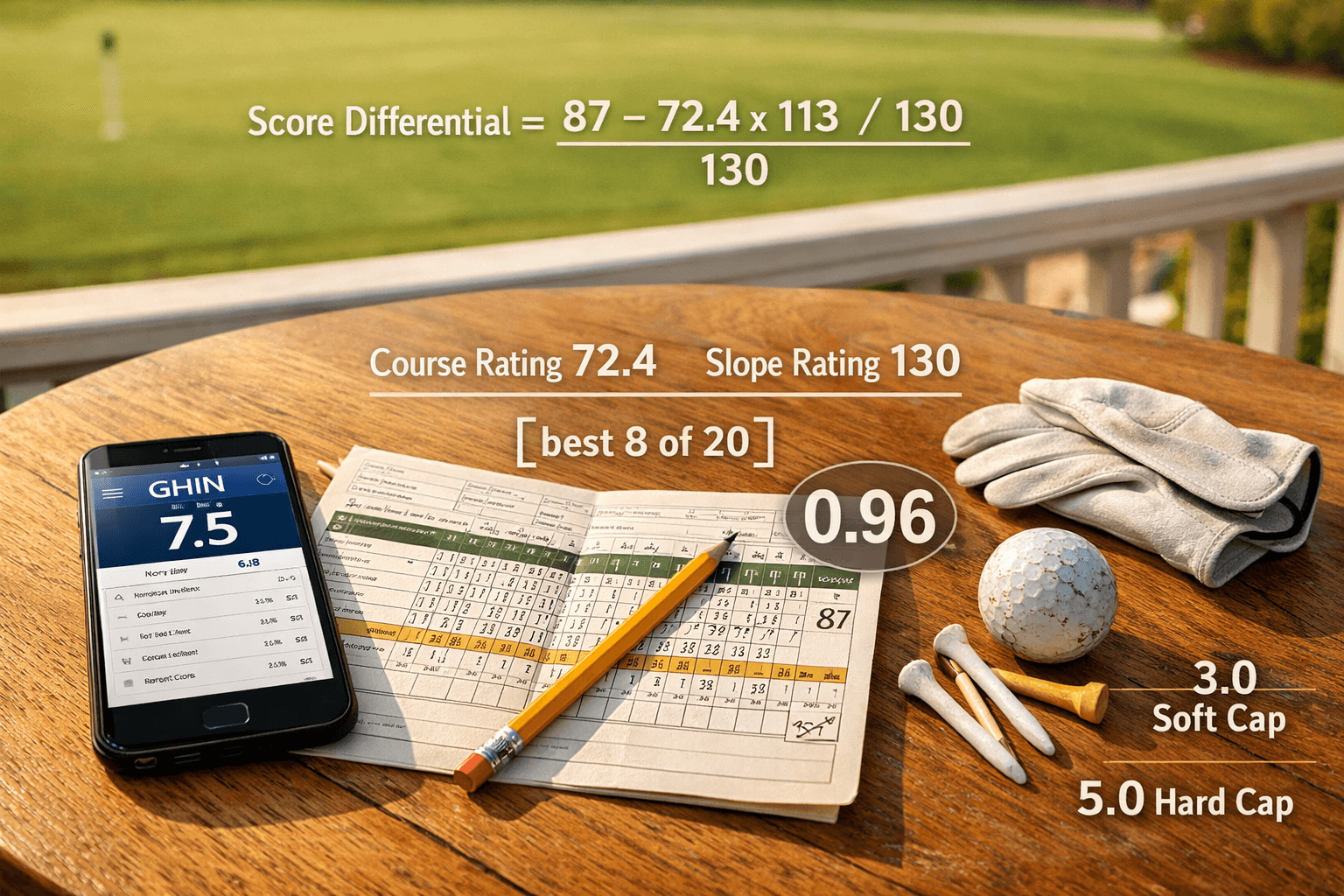
The Score Differential formula is (Adjusted Gross Score – Course Rating – PCC) x 113 / Slope Rating. It converts every round you play, on any course, into one comparable number, which is the entire point of the system.
Let’s break down each piece because the jargon is where most golfers check out.
Course Rating vs. Slope Rating: Not the Same Thing
Course Rating is the expected score for a scratch golfer (roughly a 0 handicap) under normal conditions, usually shown as something like 71.4. Slope Rating measures how much harder that course plays for a bogey golfer compared to a scratch golfer, on a scale from 55 to 155, with 113 being the average slope. A course rated 71.4/128 is noticeably tougher for a mid-handicapper than one rated 71.4/118, even though the scratch rating is identical.
These two numbers live on the scorecard, usually near the tee box info, and they change by which tees you play. The forward tees at your home course might be rated 69.5/122 while the tips are 74.1/138 — same golf course, very different numbers.
A Worked Example You Can Follow
Say you shoot a 92 on a course with a Course Rating of 71.4 and a Slope Rating of 128, with no PCC adjustment that day. The math: (92 – 71.4 – 0) x 113 / 128 = 18.2. That 18.2 is your Score Differential for that single round — not your handicap, just one data point that’ll get bundled with 19 others.
Now play a different course rated 71.4 but with a Slope of 118, and shoot that same 92. The differential drops to (92 – 71.4) x 113 / 118 = 19.7. Wait, actually let’s slow that down: lower slope means the divisor is smaller, so the differential goes up slightly in this case since the numerator stays fixed — meaning that easier course “counts against you” a bit more per stroke over the rating. The point isn’t to memorize the arithmetic. It’s to see that the same score produces different differentials depending on where you played.
Why Only Your Best 8 of 20 Scores Count
The system pulls your 20 most recent Score Differentials and averages only the lowest 8. This is the single most misunderstood part of how are golf handicap calculated, and it’s the reason your handicap can feel disconnected from your “typical” round.
If you’ve played 20 rounds this season and eight of them were noticeably better than the rest, only those eight matter. The other 12 exist in your scoring history and show up in your GHIN app, but they don’t drag your number down. This is deliberate — the WHS wants your Index to reflect your potential ability, defined as roughly the scoring level you’re capable of on a good day, not your average outing.
Here’s the table the USGA uses to determine how many differentials count, since it’s not a flat “8 of 20” until you actually have 20 rounds on file:
Rounds Played
Differentials Used
Adjustment
3-4
Lowest 1
-2.0 strokes
5-6
Lowest 1
-1.0 stroke
7-8
Lowest 2
0
9-11
Lowest 3
0
12-14
Lowest 4
0
15-16
Lowest 5
0
17-18
Lowest 6
0
19
Lowest 7
0
20
Lowest 8
0
Once you hit 20 rounds, the system also starts scrolling — it drops your oldest scores as new ones come in, always keeping a rolling window of your most recent 20. So your Index is never a permanent record. It’s a snapshot that updates, typically overnight, every time you post a new score.
The Common Mistake: Thinking It’s a Straight Average
A lot of casual golfers assume all 20 rounds get averaged together, which would mean one bad 100 tanks their number for weeks. That’s not how it works, and it’s worth saying plainly: your worst rounds are functionally invisible to your Handicap Index, as long as you’ve got enough good ones in the mix.
The 96% Multiplier and Why Your Number Feels “Better” Than Your Golf
After averaging your best 8 differentials, the system multiplies that average by 96%. This is intentional and it’s not a rounding quirk — it’s built to bias the Index slightly toward a player’s potential rather than their average performance, on the theory that on any given day you’re more likely to play up to your ability than down.
Take a golfer whose best-8 average comes out to 15.0. Multiply by 0.96 and the Handicap Index becomes 14.4. It’s a small shift, roughly half a stroke at that level, but it’s applied to everyone, every time, which keeps the system consistent across the board.
This multiplier is also why two golfers who “play about the same” can carry slightly different Indexes depending on how their good rounds cluster. It’s not favoritism. It’s just math applied uniformly, and honestly it’s one of the few parts of the whole system that doesn’t require a second look once you’ve seen it once.
Where this actually matters day to day: your Course Handicap (the number you actually use to figure strokes on the course) is calculated from this already-discounted Index, so the 96% ripples forward into every scorecard calculation you do at the first tee.
Handicap Index vs. Course Handicap: The Confusion That Costs Strokes
Your Handicap Index is one portable number that follows you everywhere. Your Course Handicap is a different number, calculated fresh for every course and every tee box you play, using your Index plus that specific course’s Slope Rating and par. Confusing the two is probably the single most common mistake among golfers who are new to reading a GHIN profile.
The formula for Course Handicap is: Handicap Index x (Slope Rating / 113), rounded to the nearest whole number. Some versions also factor in Course Rating versus par for stroke-play precision, but the slope piece is the one that actually swings the number.
Say your Handicap Index is 14.4. At a course with a Slope Rating of 130, your Course Handicap is 14.4 x (130/113) = 16.6, rounded to 17. At an easier course with a Slope of 105, that same 14.4 Index gives you 14.4 x (105/113) = 13.4, rounded to 13. Same golfer, same Index, four-stroke swing in Course Handicap just from switching courses.
Reading the GHIN App Correctly
Most GHIN apps and kiosks now calculate your Course Handicap automatically once you select the course and tee, so you rarely need to do the math yourself. Still, it helps to know why the number changes — otherwise it looks like an error every time you play somewhere new.
Why This Matters for Betting Games and Match Play
If your buddy trip involves a $5 skins game or a match against a friend, you need Course Handicaps, not raw Indexes, to set strokes fairly. Using Index numbers directly for a match at a tough, high-slope course will shortchange the higher-handicap player.
The Soft Cap, Hard Cap, and PCC: Why Your Handicap Doesn’t Swing Like You Expect
This is the part most explainers skip, and it’s the part that actually explains your day-to-day frustration. The Playing Conditions Calculation (PCC) adjusts scores after unusually easy or hard scoring days across a whole club or region, while the soft cap and hard cap stop your Index from swinging wildly in one direction.
The Soft Cap: Your Handicap Resists Getting Worse Fast
If your Index tries to increase (get worse) by more than 3.0 strokes compared to your lowest Index over the past year (called your Low Handicap Index), the system applies a soft cap — it only lets about half of the excess through. So if your unrestricted calculation would push you up 5 strokes, the soft cap trims that increase, letting through roughly 3.0 plus half of the remaining 2.0, landing around 4.0 instead of the full 5.
The Hard Cap: The Ceiling That Never Moves
No matter what, your Index can never rise more than 5.0 strokes above your Low Handicap Index within the same rolling 12-month period. This is a hard stop, not a soft nudge — even a string of brutal rounds can’t push you past it.
PCC: The Adjustment You Never See Coming
The Playing Conditions Calculation looks at scores from an entire pool of golfers at a club on a given day and, if scoring was unusually hard (wind, firm greens, brutal pin positions) or unusually easy, it nudges everyone’s differential for that day by up to 1 stroke in either direction. This happens automatically behind the scenes; you don’t request it and you won’t see it applied in real time, only reflected later in your posted differential.
Here’s the sequence that actually plays out when you post a great round:
You post your adjusted gross score into GHIN, either manually or through the app.
The system calculates that round’s raw Score Differential using Course Rating, Slope Rating, and any PCC adjustment for that day.
Your 20-round window updates, dropping the oldest round if you’re already at 20.
The system re-identifies your best 8 differentials from the new 20-round set.
It averages those 8, multiplies by 0.96, and checks the result against your soft cap and hard cap limits.
Your GHIN app displays the new Handicap Index, typically the next morning.
That’s why a single 78 doesn’t necessarily crater your Index overnight — it has to earn its way into your best 8, survive the multiplier, and clear the cap checks before it moves your number.
Getting Your First Handicap Index: What Beginners Actually Need
You need 54 holes of golf, posted honestly, to get a starter Handicap Index — no club membership required. That’s a myth worth killing early: you do not need to belong to a country club to carry an official Index. Most golfers get one through a state or regional golf association, often for a modest annual fee, sometimes under $40 depending on the state.
The 54 holes can come from any combination — three full 18-hole rounds, six 9-hole rounds, or a mix. As soon as you’ve posted enough holes, GHIN calculates a preliminary Index using the same best-differential logic, just scaled to however many rounds you’ve got.
You don’t need to join a club to sign up. Sites like golfyet.com and most state golf associations walk beginners through getting a GHIN number online, and the process usually takes less than ten minutes once you’ve got a credit card for the membership fee.
Where to Actually Post Scores
Use the GHIN mobile app, a home club kiosk, or the GHIN website — all three sync to the same account. Consistency matters more than the method; post every eligible round, not just the good ones, because the best-8 system already handles the bad ones for you.
What Counts as a Postable Round
Generally any round of at least 9 holes played under the Rules of Golf counts, including most casual rounds with friends, as long as you’re keeping an honest score hole by hole rather than just writing down a final total.
Frequently Asked Questions
Does one great round drop my handicap right away?
Not by much, and sometimes not at all. Your great round has to beat at least one of your current best 8 differentials to even count, and soft cap rules limit how fast big swings happen in either direction.
How often does my Handicap Index update?
Typically once per day, overnight, after you post a new score — GHIN recalculates automatically rather than on a fixed weekly or monthly schedule.
Can I have a handicap without belonging to a golf club?
Yes. You get an Index through a state or regional golf association and a GHIN membership, not through country club membership, and most sign-ups happen online in a few minutes.
What’s the difference between Handicap Index and Course Handicap again?
Your Handicap Index is one fixed number that travels with you everywhere; your Course Handicap recalculates for every course and tee using that Index times the local Slope Rating, so it changes constantly while your Index doesn’t.
Golf enthusiasts have a thrilling way to engage with their favorite sport through golf betting, particularly with the popular "3 ball" format. This wagering option focuses on groups of three golfers competing against each other,…
Mastering golf swing technique is crucial for players of all skill levels. It involves understanding the fundamentals and practicing the correct sequencing to connect the club head and golf ball with precision.A golf swing combines…
The Ambrose golf format is a popular team-based approach to the game that allows golfers of various skill levels to compete together effectively.Named after Richard and Mary Ambrose, who introduced this format in Australia during…