What is Golf Slope and Rating? An In-Depth Explanation
27 July, 2026Logan Hart0 Comments1 category
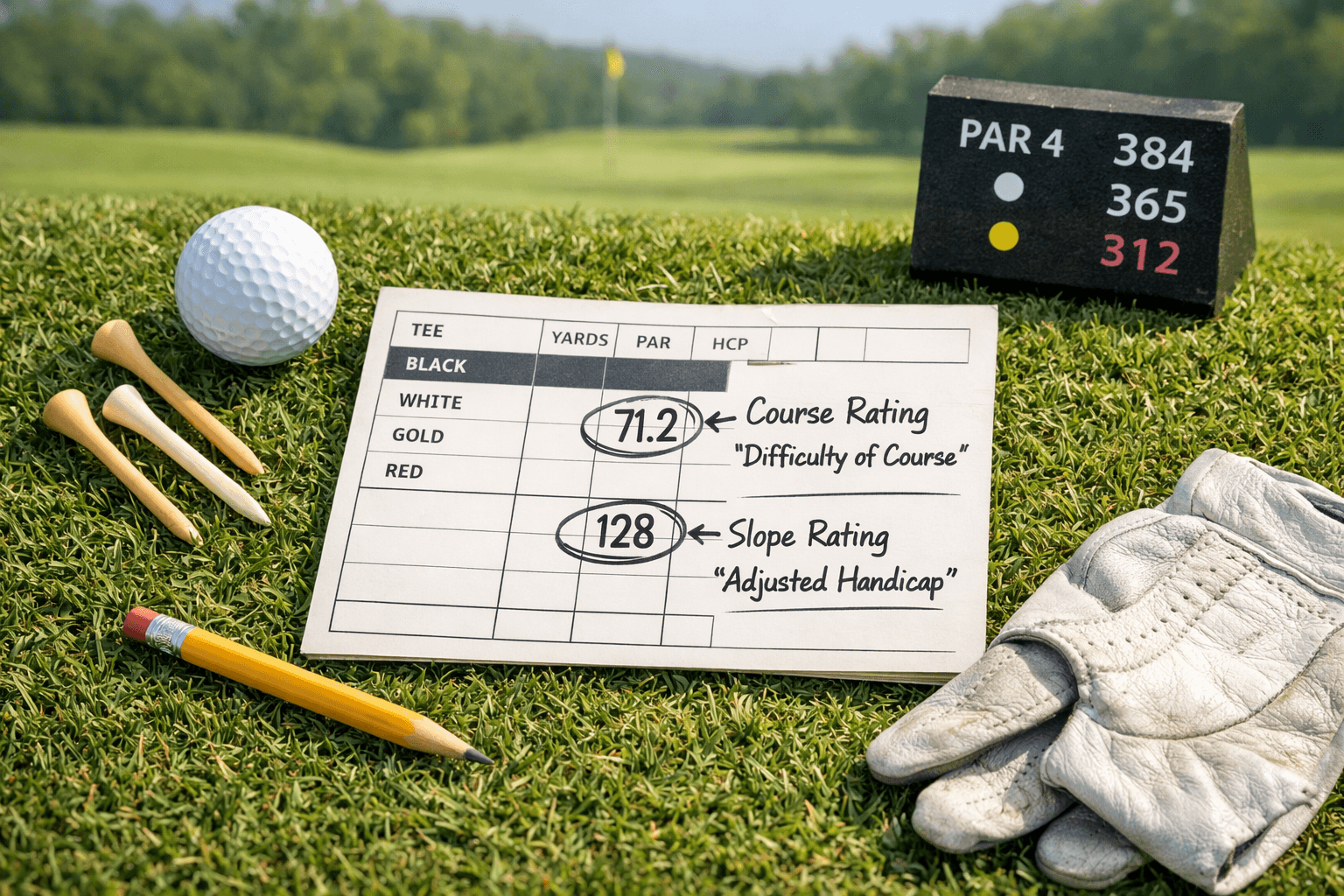
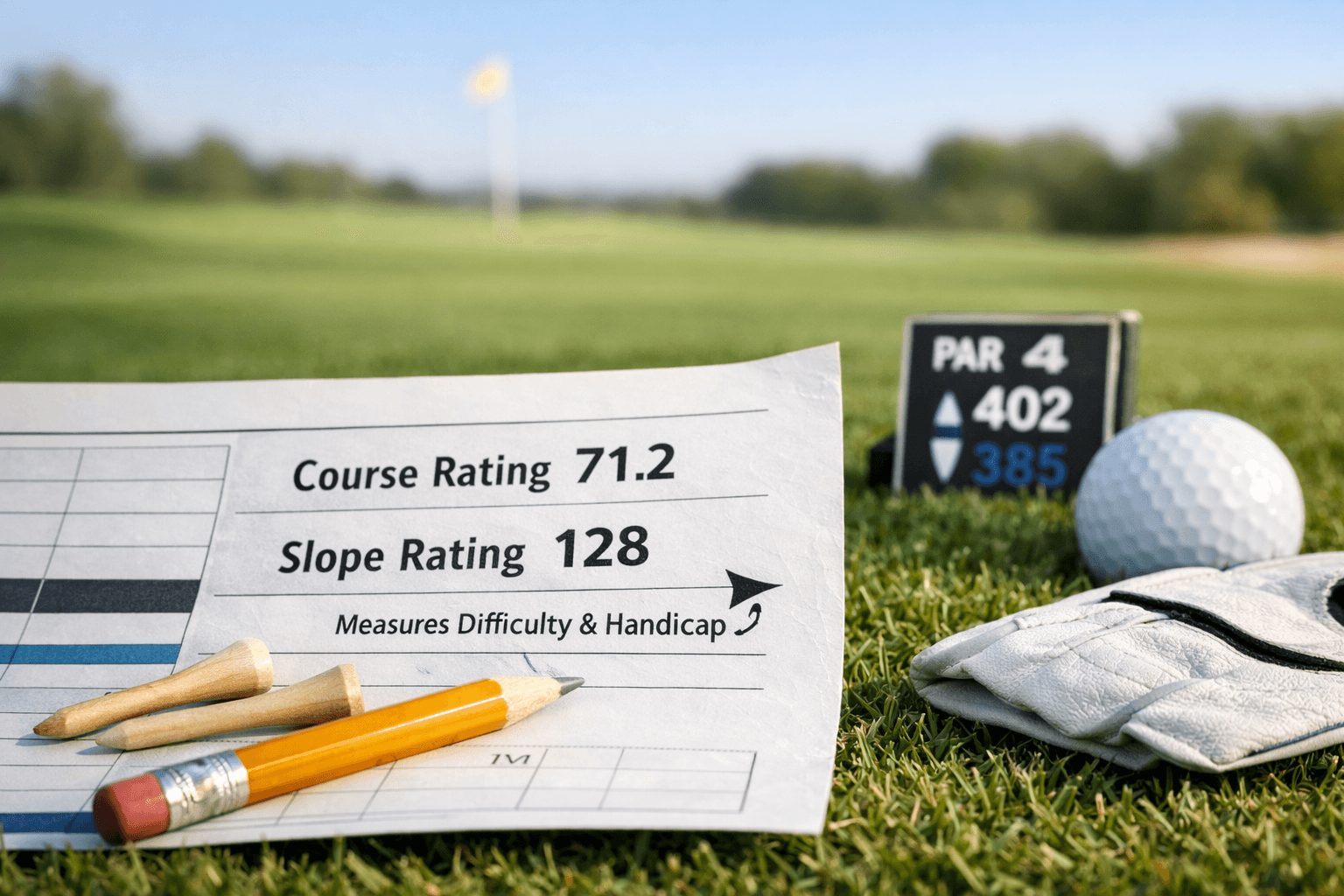
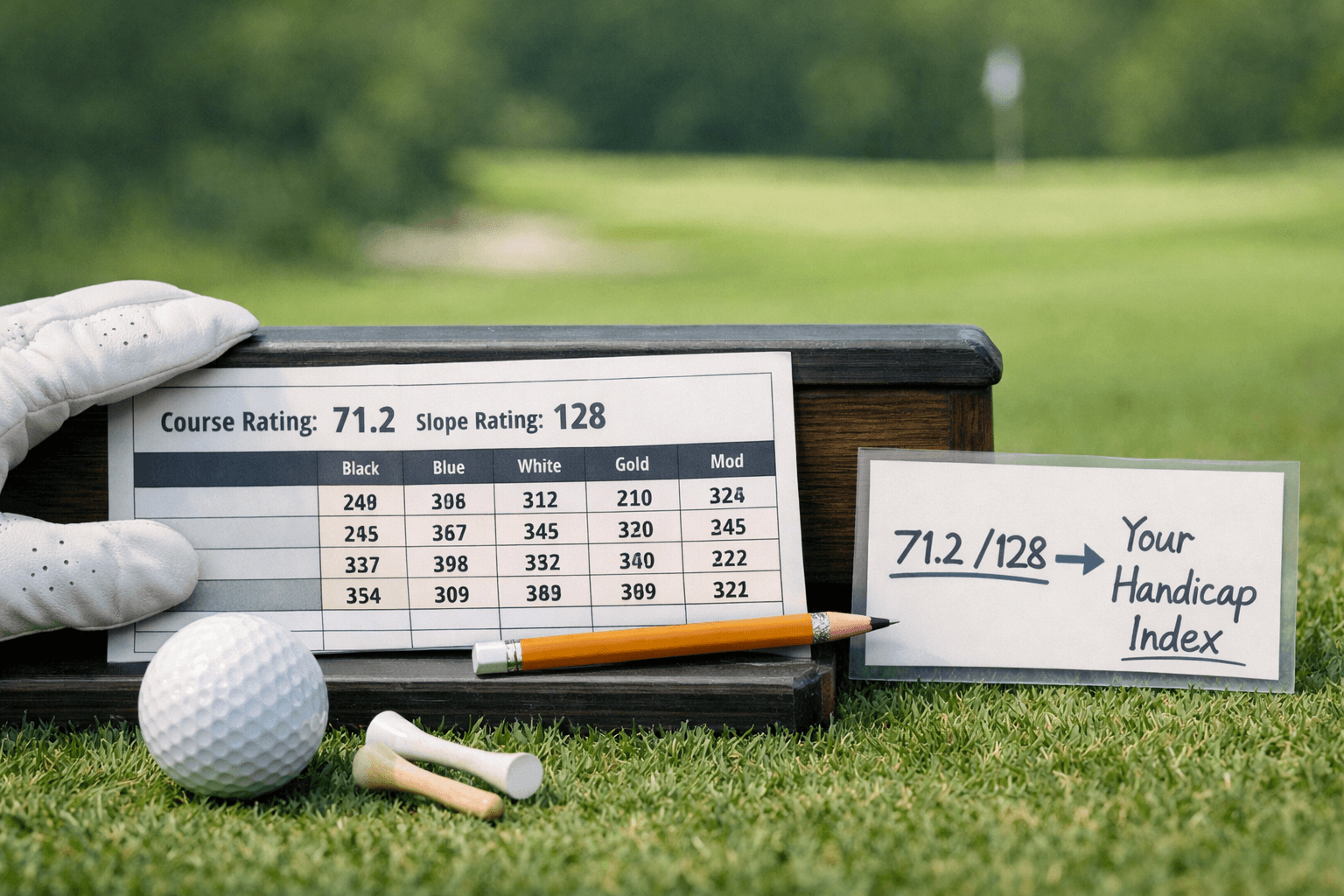
Two numbers sit on every scorecard, right next to the tee box you’re about to play, and almost nobody stops to ask what they actually mean. What is golf slope and rating, and why does a course rated 71.2 with a slope of 128 play so much harder than one rated 70.5 with a slope of 118? These aren’t random digits printed to fill space. They’re the backbone of your handicap, and they decide, more than any other stat on the card, whether the round ahead is going to humble you or let you have some fun.
Most golfers glance at these numbers, shrug, and walk to whatever tees their buddies picked. That’s the mistake this article is here to fix.
Key Takeaways
Course rating estimates a scratch golfer’s expected score; it’s not the same as par.
Slope rating measures relative difficulty for a bogey golfer, ranging from 55 to 155.
Standard, average difficulty slope is set at 113.
Your course handicap comes from slope, rating, and your handicap index combined.
Higher slope doesn’t automatically mean a longer course — hazards and green speed count too.
Picking tees by rating and slope, not ego, gives you a fairer, more enjoyable round.
Course Rating and Slope Rating Are Two Different Numbers, Not One
Course rating and slope rating get lumped together constantly, but they measure completely different things. Course rating tells you the expected score for a scratch golfer — someone with a handicap index of 0.0 — under normal conditions. Slope rating tells you how much harder the course plays for a bogey golfer compared to that same scratch golfer.
Think of it this way: course rating is about absolute difficulty for an elite amateur. Slope rating is about the gap between elite and average. A course can have a modest rating and still have a brutal slope, because the bogey golfer struggles with things that barely bother a scratch player — thick rough, forced carries, small greens that punish a mediocre short game.
This is where a lot of the confusion on scorecards starts. Golfers see two numbers near par and assume they’re variations on the same theme. They’re not. One is a projected score. The other is a difficulty multiplier based on the gap between two skill levels.
Course Rating: The Scratch Golfer’s Expected Score
Course rating is expressed in a number close to par, usually with one decimal point, like 72.3 or 69.8. That number represents what the United States Golf Association (USGA) Course Rating System calculates as the expected score for a scratch golfer playing under normal course and weather conditions from a specific set of tees.
A course rating of 72.3 on a par-72 course means a scratch golfer is expected to shoot slightly over par on average. A rating of 69.8 on that same par-72 course means the course actually plays a bit easier than its par suggests for a top-level player. That gap between rating and par is itself useful information, and it’s often overlooked.
Slope Rating: The Bogey Golfer’s Relative Struggle
Slope rating is a three-digit number that captures how much harder the course plays for a bogey golfer (around a 20 handicap) relative to a scratch golfer. The USGA set the standard slope at 113, representing average difficulty. Slope ratings range from 55, the easiest allowed, to 155, the most difficult.
A slope of 145 doesn’t mean the course is longer. It means the difficulty gap between a scratch player and a bogey player is wide — often because of narrow landing areas, deep bunkers, or greens that roll fast enough to turn three-putts into a common outcome for less consistent players.
What Slope Rating Actually Measures (And What It Doesn’t)
Slope rating measures the relative difficulty a course presents to a bogey golfer compared to a scratch golfer — not overall difficulty, and not length. This distinction trips up more golfers than almost anything else on the scorecard.
Here’s the common misread: a golfer sees a slope of 150 and assumes the course is just flat-out hard for everybody. That’s not quite right. Slope specifically isolates the extra trouble a higher-handicap player runs into that a scratch golfer mostly avoids. A scratch golfer clears the fairway bunker at 260 yards without thinking twice. A bogey golfer, hitting shorter and less accurately, finds that same bunker regularly. That gap is what slope captures.
Slope rating is a USGA measurement, on a scale of 55 to 155, of the relative difficulty of a course for bogey golfers compared to scratch golfers, with 113 representing a course of standard difficulty.
Why a Higher Slope Doesn’t Mean a Longer Course
Length and slope often move together, but not always. A short course with small, fast greens, deep rough, and tight tree-lined fairways can carry a higher slope than a longer, wide-open course with generous fairways. The factors that drive slope include effective playing length, bunker placement, rough height, green speed, and the severity of forced carries — not yardage alone.
Take two hypothetical municipal courses in the same region: one stretches to 6,800 yards but has wide fairways and forgiving greens, while a shorter 6,200-yard course squeezes players between water hazards and demands precise approach shots to small targets. The shorter course can easily post the higher slope. Distance is one input among several, and it’s rarely the deciding one.
Why Slope Isn’t the Same as “How Hard the Course Is” for Everyone
Slope specifically compares two reference points — scratch and bogey — so it says nothing directly about how a 5-handicap or a 30-handicap will experience the course. It’s a proxy, a useful one, but it’s built around those two benchmarks. A very skilled player and a beginner might both find a high-slope course tough, but for different reasons, and the slope number itself doesn’t explain why.
How Course Handicap Is Calculated From Slope and Rating
Your course handicap is the number you actually play off on a given day, and it comes from a formula that uses your handicap index, the slope rating of the tees you’re playing, and the course rating relative to par. The World Handicap System formula is: Course Handicap = Handicap Index × (Slope Rating ÷ 113) + (Course Rating − Par).
That middle term, dividing slope by the standard 113, is what adjusts your handicap up or down based on how tough the specific tees are. Play a slope of 140 and your course handicap climbs. Play a slope of 100 and it drops, even with the same handicap index.
The final term, course rating minus par, accounts for the small gap between what a scratch golfer is expected to shoot and the course’s fixed par number. On most courses, that number is small — half a stroke to a stroke and a half — but it does move your number slightly.
Here’s a worked example. Say your handicap index is 12.4, and you’re playing tees with a slope of 128 and a course rating of 71.6 on a par-72 layout. Plug it in: 12.4 × (128 ÷ 113) = 14.0, then add (71.6 − 72) = -0.4. Your course handicap comes out to about 13.6, which rounds to 14.
Find your current handicap index from your golf association’s app or the USGA GHIN system.
Locate the slope rating and course rating for the specific tees you plan to play.
Divide the slope rating by 113.
Multiply that result by your handicap index.
Add the difference between course rating and par (this can be negative).
Round to the nearest whole number — that’s your course handicap for the day.
Recalculate any time you switch tee boxes, even on the same course.
Most rangefinder apps and GHIN mobile tools do this math instantly once you select your tees, so you rarely need to do it by hand. But understanding the formula matters because it explains why your number changes from course to course, and even from one set of tees to another on the same course.
Scratch Golfer vs. Bogey Golfer: The Two Benchmarks Behind Every Number
Every slope and rating calculation hinges on two reference players who don’t exist on your local course but shape everything on the scorecard. A scratch golfer, by definition, has a handicap index of 0.0. A bogey golfer sits around 20 for men and roughly 24 for women under the USGA‘s modeling assumptions.
These aren’t real people tracked and tested. They’re statistical constructs, built from decades of scoring data, used to model how a course plays across the skill spectrum. The scratch golfer’s expected score on a hole factors driving distance around 250 yards and strong short-game consistency. The bogey golfer’s model assumes shorter drives, more missed greens, and more three-putts.
This matters because it explains why the same hole can feel wildly different to two golfers standing on the same tee. A 440-yard par 4 with a fairway bunker at 230 yards barely registers for the scratch model — that bunker is short of a good drive. For the bogey model, that same bunker sits right in the likely landing zone. The course rating system quantifies exactly that kind of gap, hole by hole, then rolls it into the two numbers on your scorecard.
Where this gets practical: your handicap index tells you where you fall relative to these two benchmarks, not to the actual golfers you’re playing with today. A 15-handicap golfer is statistically between scratch and bogey, and the slope-adjusted course handicap formula is what translates that position into a usable number for any specific set of tees.
Course Rating Is Not Par — Clearing Up the Most Common Mix-Up
Course rating and par look similar on a scorecard, both hovering in the high 60s to low 70s, and that similarity causes real confusion. Par is a fixed, whole-number target set by course design — how many strokes a hole is supposed to take with two putts included. Course rating is a decimal-based measurement of expected scratch-golfer performance, and it can sit above or below par.
A course with a par of 72 might carry a course rating of 74.1 from the back tees. That doesn’t mean the course designer set par wrong. It means the back tees play harder than the flat par number suggests, once you account for length, hazard placement, and green conditions. Scratch golfers, on average, are expected to shoot around 74 rather than 72 from that set of tees.
Flip it around, and a course rated 68.9 against a par of 71 tells you the opposite story: this layout, from these tees, actually plays a bit easier for a strong player than its par implies. Shorter par 5s that are reachable in two, wide fairways, and forgiving green complexes all push the rating below par.
Why This Confusion Costs You Strokes on Your Handicap
If you mistake course rating for par, you’ll misjudge your own performance relative to the field. Shooting an 88 on a course rated 74.2 is a genuinely different accomplishment than shooting an 88 on a course rated 69.5, even though the par might read 72 on both cards. The handicap system already accounts for this through the (Course Rating − Par) term in the formula — but understanding it helps you read your own scores honestly, instead of getting discouraged by a number that doesn’t reflect the course you actually played.
A Quick Way to Remember the Difference
Par is what the architect designed the hole to require. Course rating is what the data says a scratch golfer will actually shoot. They agree more often than not, but treat them as two separate facts, not one number repeated twice.
Picking Tees by Slope and Rating, Not by Ego
This is the part most explainers skip, and it’s the part that actually changes how much fun you have on the course. Picking tees should be based on your handicap index matched against the slope and rating of each tee box — not on what color looks “manly enough” or what your regular foursome always plays.
Playing tees that are too long for your handicap index doesn’t just add strokes. It piles on forced carries you can’t clear, approach shots from distances that don’t match your iron game, and a pace-of-play headache for everyone behind you. A course handicap calculated on tees that don’t suit you produces a number that overstates how forgiving your day will actually be.
How to Read a Multi-Tee Scorecard
Most scorecards list four or five tee options, each with its own yardage, course rating, and slope rating. The gap between the longest and shortest tees on a single course can run from a slope of 130-plus down into the low 110s, sometimes lower.
Tee Color
Yardage
Course Rating
Slope Rating
Black
7,050
74.5
138
Blue
6,600
72.1
131
White
6,150
69.8
124
Gold
5,600
67.4
117
Red
5,050
65.0
112
Notice how both course rating and slope drop together here, which is typical but not guaranteed — remember the earlier point about short, tight courses posting surprisingly high slopes.
A Simple Rule for Choosing Your Set of Tees
A workable rule: if your handicap index is above 15, you should rarely be playing anything with a slope over 130 for casual rounds. If you’re new to the game entirely, look for the tees with the lowest slope on the card, regardless of what everyone else in your group chooses — nobody’s timing your round, and nobody cares which color you played once the group’s off the first tee.
The ego cost of playing forward tees is imaginary. The stroke cost of playing tees that don’t match your handicap is real, and it shows up in your scoring average, your pace of play, and honestly, how much you enjoy the back nine. Sites like golfyet.com break down specific course scorecards if you want to check slope and rating before you even show up, which takes the guesswork out of it before you’re standing on the first tee arguing with your group about which markers to hit from.
How Slope and Rating Feed Into Your Handicap Index Over Time
Your handicap index isn’t calculated from one round — it’s built from a rolling record of your best differentials across your last 20 rounds, and each differential depends directly on the slope and rating of the tees you played. This is the mechanism that makes the whole system fair across different courses.
The score differential formula for each round is: (Score − Course Rating) × 113 ÷ Slope Rating. That 113 in the formula is the same standard slope number from earlier — it’s the anchor that normalizes every course back to a common baseline, regardless of how tough or easy the specific layout was that day.
Here’s why that matters practically. Shoot a 95 on a slope-140 course rated 73.5, and your differential comes out lower — meaning it looks better for handicap purposes — than shooting that same 95 on a slope-105 course rated 68.0. The system recognizes that a 95 on a tougher setup reflects better play, even though the raw score is identical.
Why Playing Tougher Courses Occasionally Helps Your Handicap
Golfers who only ever play easy, low-slope courses near home sometimes wonder why their handicap doesn’t drop even as their scores improve. Playing a genuinely tougher course, from the right tees for your level, and posting a solid score there can produce a better differential than a personal best score. Occasionally testing yourself on higher-slope layoup — while still on tees appropriate to your handicap — actually helps the accuracy of your index over time.
Watch Out for Mixed Tee Rounds
If you play different sets of tees during a round, or your group mixes and matches, note that most handicap systems require posting from a single consistent set of tees for that round to count cleanly. Mixing tees mid-round without recording it properly can throw off your differential and, over enough rounds, skew your handicap index in ways that don’t reflect your actual game.
Frequently Asked Questions
What does a slope rating of 130 actually mean for my round?
A slope of 130 is above the standard of 113, meaning the course plays noticeably harder for a bogey golfer relative to a scratch golfer than an average course does. Expect your course handicap to run higher there than on a lower-slope layout with the same yardage.
Can two courses have the same par but very different slope ratings?
Yes, easily. Par only reflects the number of strokes each hole is designed for; slope reflects relative difficulty factors like hazard placement, green speed, and rough. A par-72 course can carry a slope of 155, the maximum, while another par-72 course sits near 100.
Is a course rating always close to par?
Not always — course rating can run above or below par depending on tee length and conditions. A tough back-tee setup might rate 74 or higher on a par-72 course, while a shorter, forgiving front-tee setup on the same course might rate under 69.
Do women and men use the same slope rating on the same tees?
No, ratings are calculated separately for men and women because the bogey and scratch benchmarks differ by gender under USGA modeling. The same tee box often has two distinct course rating and slope numbers listed on the card, one for each.
Golfers looking to add a competitive edge to their game may want to try the Golf Wolf game, a strategic betting game that combines individual skill with team dynamics.This engaging game is typically played with…
Understanding the rule for a provisional ball is crucial in golf, as it can save time and maintain pace of play when your original ball might be lost or out of bounds.The rule, outlined in…
A used Scotty Cameron Newport 2 from the early 2000s can sell for more than a brand-new Phantom X off the rack. That's not a typo — it's the used-golf-club market doing what collector markets…