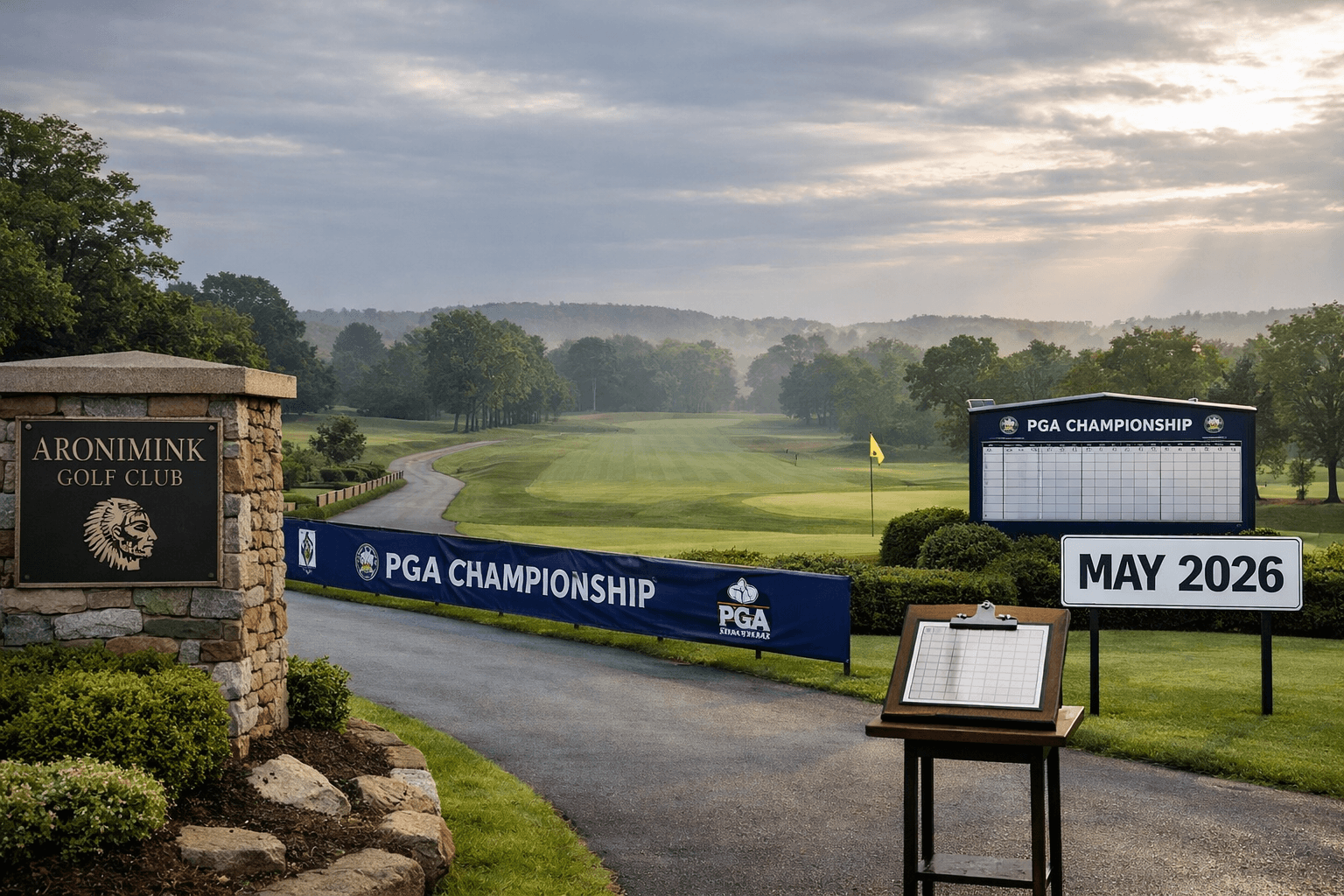
PGA Championship 2026: Dates and Venue Information
30 July, 2026Logan Hart0 Comments1 category
Mark your calendar for a course most golf fans have never seen on TV: Aronimink Golf Club near Philadelphia hosts the PGA Championship 2026, and it’s not the venue you’re used to hearing about every May. This event runs in the second full week of May 2026, and it lands at a classic Donald Ross design that’s been waiting decades for a moment like this. If you’re trying to figure out when to clear your schedule and where to point your streaming app, here’s the breakdown.
Casual fans searching “PGA Championship 2026” usually want three things fast: the dates, the course, and why this year’s setup matters. Aronimink hasn’t hosted a men’s major before, which makes 2026 a genuine changeup from the usual rotation of Bethpage, Oak Hill, and Southern Hills. That alone is worth paying attention to.
Key Takeaways
PGA Championship 2026 is set for May 2026 at Aronimink Golf Club
Venue sits in Newtown Square, Pennsylvania, outside Philadelphia
Course was designed by Donald Ross, opened in 1928
Aronimink has never hosted a men’s major championship before
PGA of America runs this event, separate from the PGA Tour
Field qualification differs from the Masters and other majors
When Is the PGA Championship 2026?
The PGA Championship 2026 is scheduled for May 2026, following the tournament’s now-standard spot as the second major of the year. The PGA of America moved the championship to May starting in 2019, and it’s stuck there since, giving golf fans a major every month from April through July with breathing room between them.
That May slot isn’t random. Before 2019, the PGA Championship sat in August, often competing for attention with football season kickoff buzz and NFL preseason chatter. Moving it to May gave the event its own window, right after the Masters in April and well before the U.S. Open in June.
Expect the tournament to run Thursday through Sunday, the standard four-round format for a major. Practice rounds and pro-am events typically start the Monday or Tuesday of that week, so if you’re planning a trip to Newtown Square, budget for arriving a day or two early if you want to catch players working the range.
Weather in the Philadelphia area during May is usually cooperative for golf. Average highs run in the mid-60s to low-70s Fahrenheit, with occasional rain showers that Northeastern spring weather is known for. It’s rarely brutally hot, but a cold snap or a rain delay isn’t out of the question this early in the season.
Major championship golf in the Northeast in May means packing layers — mornings can start in the 50s even when afternoons warm up nicely.
One thing worth noting: exact tee times and the finalized daily schedule usually don’t get announced until a few months out, so if you’re planning travel, watch the PGA of America’s official channels as the date approaches for hole-by-hole and broadcast details.
Where Is It Being Played? Aronimink Golf Club Explained
Aronimink Golf Club sits in Newtown Square, Pennsylvania, roughly 15 miles west of downtown Philadelphia. It’s a private club that’s hosted plenty of notable amateur and PGA Tour events over the decades, but never a men’s major championship until 2026.
The Course’s Pedigree
Aronimink opened in 1928, designed by Donald Ross, one of the most influential architects in golf history. Ross also designed Pinehurst No. 2, Oakland Hills, and dozens of other courses that have hosted majors. Aronimink is widely considered one of his finest works, even though it’s flown under the radar compared to his more famous designs.
The course has hosted the PGA Tour‘s AT&T National in the past and multiple USGA amateur championships, so it’s not unfamiliar with big-time golf. What it hasn’t done is host a men’s major, and that’s exactly why 2026 is a big deal for people who follow classic course architecture.
Why This Location Matters for the Field
Aronimink plays to a par of 70, which is shorter on paper than some modern major venues but makes up for it with tight fairways, small greens, and the kind of strategic bunkering Ross was known for. Players who rely purely on distance won’t have the same advantage they’d get at a longer, more modern layout.
The course’s tree-lined corridors and rolling terrain also mean wind won’t be as big a factor as it is at seaside or links-style venues. Expect scoring to hinge more on iron play and putting than raw power off the tee.
For fans, this matters because it changes what kind of player has an edge. A precise ball-striker with a hot putter could easily outduel a bomber who can’t find the fairway.
Why a Donald Ross Design Without Major History Is a Big Deal
This is the differentiator for 2026: Aronimink is a genuinely new stage for major championship golf, not another lap around the same handful of famous courses. That’s rare, and it’s worth understanding why.
Most major venues rotate through a familiar list. Think Oakmont, Winged Foot, Bethpage Black, Southern Hills. Fans have seen these courses dozens of times on TV, know the famous holes, and can predict roughly how they’ll play. Aronimink breaks that pattern entirely.
A Fresh Test for Today’s Best Players
Because no modern major has been played there, players don’t have decades of shot data or personal history to draw on. Everyone starts closer to even in terms of course knowledge. That’s a rare situation in a sport where course familiarity often matters as much as skill.
Ross-designed courses tend to reward shot-shaping and smart course management over pure power, which is a different test than the modern “bomb and gouge” style some newer major venues encourage. Watching how today’s longest hitters adjust to smaller, older-style greens is genuinely interesting, even for fans who don’t normally care about course architecture.
What Casual Fans Should Watch For
Keep an eye on how players handle the greens specifically. Ross greens are famous for subtle slopes and false fronts that reject shots that look perfect in the air. A ball that lands on the green can still roll off it. That’s the kind of drama that makes for compelling weekend viewing, even if you don’t know a single technical golf term.
If you want more explainers like this on how different major courses shape the way tournaments play out, sites like golfyet.com break down course strategy in plain language without assuming you already know the jargon.
PGA Championship vs. Other Big Golf Events: Clearing Up the Confusion
The PGA Championship is one of golf’s four men’s major championships, run by the PGA of America — not the PGA Tour, and not the same thing as the Players Championship or the FedEx Cup playoffs. Mixing these up is one of the most common mistakes casual fans make.
Here’s the simple version: the PGA of America is a separate organization from the PGA Tour. The PGA of America represents club professionals and teaching pros across the country, and it runs the PGA Championship along with the Ryder Cup (in even years) and several other events. The PGA Tour, on the other hand, runs the weekly tour schedule, the Players Championship, and the FedEx Cup playoff series in the fall.
The Players Championship, despite its massive purse and stacked field, is not a major. It’s a PGA Tour event, typically played at TPC Sawgrass in Florida every March. The FedEx Cup is also a PGA Tour property, a season-long points race that wraps up with the Tour Championship in August.
So when someone says “PGA Championship,” they specifically mean the major run by the PGA of America. Here’s a quick comparison to keep it straight:
Event
Governing Body
Major Status
Typical Timing
PGA Championship
PGA of America
Yes
May
Players Championship
PGA Tour
No
March
FedEx Cup / Tour Championship
PGA Tour
No
August
Masters
Augusta National Golf Club
Yes
April
U.S. Open
USGA
Yes
June
The Open Championship
R&A
Yes
July
That table alone clears up a lot of confusion I’ve seen from casual fans who assume “PGA” in a tournament name always means the same governing group. It doesn’t, and knowing the difference makes following the major championship schedule a lot less confusing.
Does the Venue Change Every Year? Yes, and Here’s How It’s Picked
Unlike the Masters, which is played at Augusta National every single year without exception, the PGA Championship moves to a different course annually. This confuses plenty of casual fans who assume all majors work like the Masters does.
The PGA of America selects venues years in advance, often five to ten years out, based on a mix of factors: course quality, infrastructure for hosting tens of thousands of spectators, hotel and travel access, and a club’s willingness to host. Aronimink was announced as a future host well ahead of 2026, giving the club years to prepare its grounds and facilities for major championship logistics.
Past Venues Show the Pattern
Recent PGA Championship venues include Valhalla Golf Club in Louisville (2024), Oak Hill Country Club in Rochester (2023), and Southern Hills Country Club in Tulsa (2022). Before that, Kiawah Island’s Ocean Course hosted in 2021. Notice the pattern: a mix of well-known championship courses spread across different regions of the country, rarely repeating in consecutive years.
This rotation is part of what makes each PGA Championship feel distinct. Fans get a new visual identity, new weather patterns, and often a new type of course challenge every single year, rather than watching the same 18 holes get picked apart annually like at Augusta.
Future Scheduling Beyond 2026
The PGA of America typically has host sites locked in years ahead, and past reporting has pointed to venues like Aronimink for 2026, with the rotation continuing to notable clubs in subsequent years. If you’re the type who likes planning golf trips around majors, it’s worth checking the PGA of America’s official site periodically, since host announcements can shift due to course renovations or unforeseen circumstances.
One quirk worth remembering: because venues change constantly, course records and scoring history don’t carry the same weight fans expect from Augusta comparisons. Nobody’s chasing a 30-year-old scoring record at Aronimink, because nobody’s played a major there before.
Who Qualifies to Play? Field Criteria Explained
Qualification for the PGA Championship works differently than other majors, and that trips up a lot of fans who assume all four majors use identical criteria. The field is capped at 156 players, and it includes a mix of top professionals, PGA of America club professionals, and category-based exemptions.
Categories That Get Players In
The PGA Championship offers exemption categories that don’t exist at the other majors, most notably a set of spots reserved for the top finishers at the PGA Professional Championship, an event specifically for club and teaching professionals rather than tour pros. This is a distinguishing feature: it’s literally in the name, since the PGA of America represents working club professionals nationwide, and the championship reflects that membership.
Beyond that, the bulk of the field comes from standard categories familiar to major championship followers.
Winners of the PGA Championship going back a set number of years
Winners of other recent majors, including the Masters, U.S. Open, and Open Championship
Top finishers from the Official World Golf Ranking close to the event
Top money leaders and points leaders from the PGA Tour season
A designated number of top finishers from the PGA Professional Championship
Special exemptions awarded by the PGA of America at its discretion
Why This Differs From Other Majors
The Masters relies heavily on invitations tied to amateur titles, past champions, and top finishes in previous majors, with a notably smaller field around 90 players. The U.S. Open runs an open qualifying system where literally thousands of golfers, including amateurs and club pros, attempt to qualify through local and sectional qualifying rounds. The PGA Championship’s structure sits somewhere in between, blending world ranking exemptions with its unique club professional pathway.
This matters for casual fans because it explains why you’ll occasionally see an unfamiliar name in the PGA Championship field who isn’t a full-time tour pro. That’s not a mistake or a wildcard fluke. It’s the system working as designed, giving working club professionals a real shot at playing alongside major champions.
Getting There: Tickets, Hospitality, and What to Expect
Tickets for the PGA Championship typically go on sale roughly a year in advance through the PGA of America’s official ticket portal, and demand tends to spike once pairings and featured groups get announced closer to the event. Expect daily grounds passes, weekly packages, and hospitality options at multiple price points.
Ticket Types Worth Knowing
Grounds passes get you access to walk the course and watch play from spectator areas, while hospitality packages add climate-controlled viewing areas, food and beverage service, and often better sightlines near marquee holes. Prices vary significantly year to year and by day, with weekend rounds (Saturday and Sunday) generally costing more than Thursday or Friday practice-adjacent days.
Given Aronimink’s proximity to Philadelphia, expect a mix of local day-trippers and traveling golf fans booking hotels in the surrounding suburbs. Newtown Square itself is small, so most lodging options will be in nearby towns or closer to Philadelphia proper, roughly a 20-30 minute drive depending on traffic and event-day road closures.
Practical Tips for Attending
If you’re planning to attend, book lodging early. Major championship weeks routinely sell out hotels within a 30-mile radius months in advance, and prices climb the closer you get to the event. Renting a car isn’t strictly necessary if you’re staying near Philadelphia’s public transit lines, but shuttle service to the course itself is typically provided by the tournament for ticket holders parking off-site.
Weather-wise, pack for variability. May in the Philadelphia region can swing from a chilly, damp morning to a warm afternoon, so layers beat a single heavy jacket or a t-shirt-only approach. Sunscreen still matters even on cloudy days, since you’ll likely be walking several miles around the course if you’re following groups on foot.
Frequently Asked Questions
Is the PGA Championship the same as the Players Championship?
No. The PGA Championship is a major run by the PGA of America, while the Players Championship is a PGA Tour event at TPC Sawgrass with a huge purse but no major status.
Has Aronimink Golf Club ever hosted a major championship before?
No, 2026 marks Aronimink’s first men’s major championship, despite hosting PGA Tour events and USGA amateur championships in past decades since its 1928 opening.
Why does the PGA Championship move venues every year instead of staying at one course?
Unlike the Masters at Augusta National, the PGA of America selects a new host club years in advance, spreading the event across different regions and course styles nationwide.
How is the PGA Championship field different from the Masters or U.S. Open?
It caps at 156 players and includes exemptions for top finishers at the PGA Professional Championship, a category specific to club professionals that doesn’t exist at other majors.
The personal transportation landscape is undergoing a significant shift, with vehicles like the Tomberlin E-Merge GT redefining the boundaries between golf carts and street-legal automobiles. As communities increasingly adopt Low-Speed Vehicles (LSVs) for neighborhood transportation,…
Six men have won the Masters Tournament more than once, and understanding who they are tells you almost everything about what Augusta National rewards. If you're searching for master golf winners, you're in the right…
At 5 foot 7, weighing barely 68kg, Gary Player didn't look like a man who'd out-work golfers twice his size for six decades. Yet the South African built one of the sport's great careers on…